
Risk warning: CFDs are complex instruments and come with a high risk of losing money rapidly due to leverage. The majority of retail investor accounts lose money when trading CFDs. You should consider whether you understand how CFDs work and whether you can afford to take the high risk of losing your money. This page is general information, not financial advice. Advertiser disclosure.
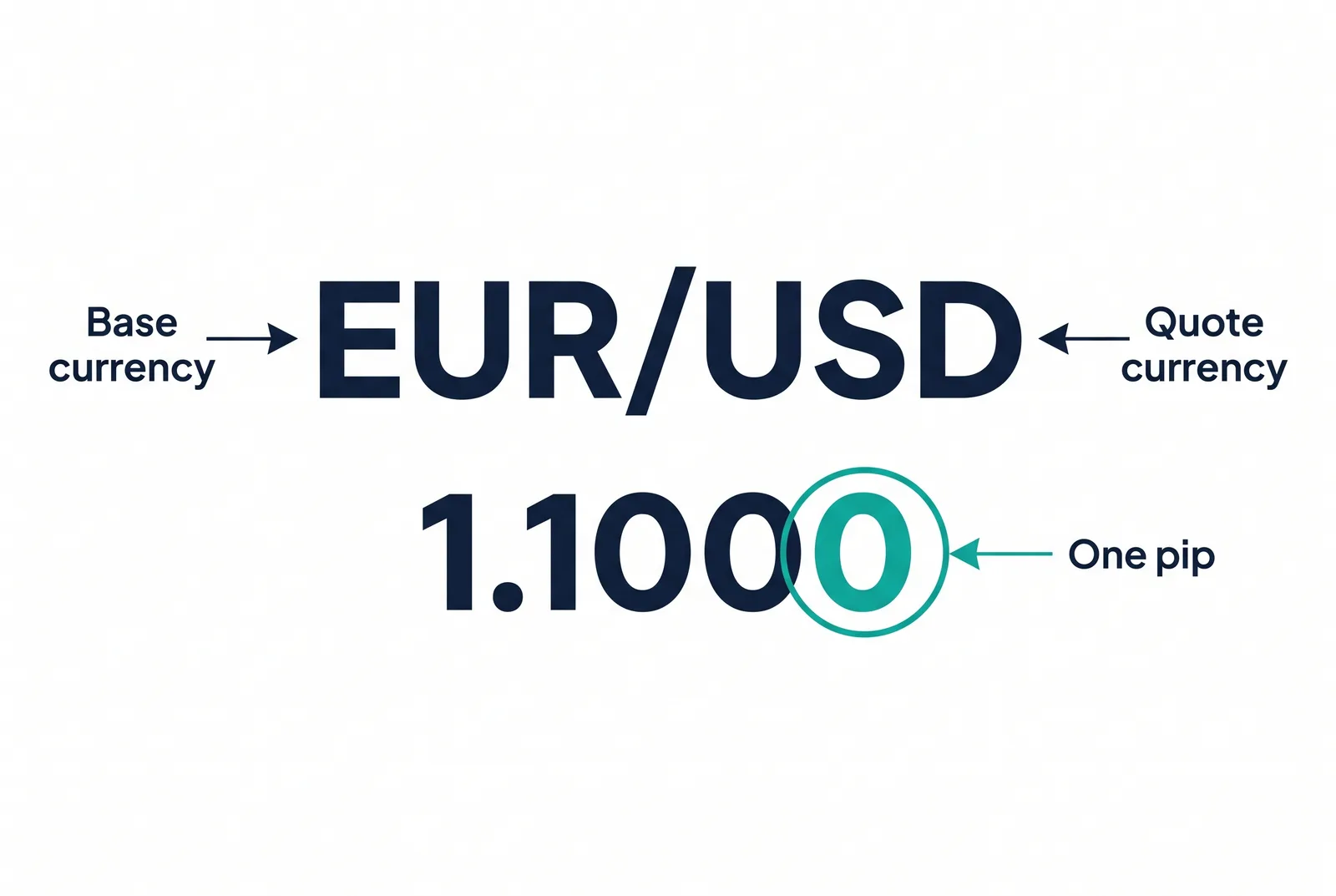
A currency pair quotes one currency against another. I think of GBP/USD as the base (sterling) and the quote (dollar); buying the pair means buying the base and selling the quote. UK traders work with three groups: majors, minors and crosses, each carrying its own spread and FCA leverage cap.
Majors, minors and crosses
Major pairs include the most traded currencies against the US dollar, such as EUR/USD and GBP/USD, and carry the tightest spreads. Minor pairs trade currencies against each other without the dollar, like EUR/GBP. Crosses and exotics pair a major currency with a smaller-economy currency and carry wider spreads. GBP/USD, nicknamed cable, is the pair most UK traders watch first. If you are watching the pound, that is the pair you check. Traders prioritising the tightest major-pair spreads often compare ECN forex brokers, which pass raw interbank pricing through with a separate commission.
| Pair type | Example | Typical spread | FCA leverage cap |
|---|---|---|---|
| Major | EUR/USD, GBP/USD | Tightest; advertised from around 0.0 to 0.2 pips (broker sites, accessed July 2026) | 30:1 |
| Minor | EUR/GBP | Wider than majors; advertised from around 0.2 pips upward (broker sites, accessed July 2026) | 20:1 |
| Cross/exotic | GBP/ZAR | Widest of the three groups | 20:1 |
Spreads shown are advertised from-rates on raw-spread or ECN accounts (broker sites, accessed July 2026), not figures we have independently measured. Your actual spread depends on account type, session liquidity and volatility.
A GBP pip-value example
I always tell traders to know their pip value in sterling before they size a trade. A pip is the fourth decimal place on most pairs, and pip value depends on position size and the quote currency. On a standard lot of GBP/USD, one pip is worth USD 10, which converts to £7.36 at a GBP/USD rate of 1.3592 (28 August 2026); on a mini lot, £0.74. The rate is updated regularly to give you a current figure. The US dollar amount is fixed by the contract size; the sterling figure moves with the exchange rate, so I would recheck it before a session. Knowing pip value in GBP lets a UK trader size a position to a fixed pound risk per trade rather than guessing. Our pip value calculator does the conversion for any pair, lot size and account currency at current rates.
Pip Value Calculator
Rates as of Fri 28 Aug 2026, 5pm New York close
£7.36per pip at 1.00 lot(s)
- Pip size0.0001
- Contract size100,000 units per lot
- Conversion rate (USD to GBP)0.7357
GBP/USD pip value at one standard lot, 28 August 2026. Pip size is 0.0001 and one standard lot is 100,000 units of the base currency, so one pip moves the position by 0.0001 x 100,000 = US$10.00 in the quote currency. Converting at £0.7357 per US dollar, a GBP/USD rate of 1.3592, gives £7.36 per pip on a standard lot and £0.74 on a mini lot of 10,000 units.
What leverage applies to each currency pair type?
Major currency pairs carry the 30:1 retail leverage cap under the FCA’s PS19/18 rules, and non-major pairs are capped at 20:1. In my view, the cap reflects liquidity and volatility, so the same £1,000 of margin controls less exposure on a minor pair than a major. If you see a 500:1 figure, that broker is offshore and outside FCA regulation. I would treat that as a red flag and check the broker against FCA-regulated broker reviews before funding an account.
How currency pairs move together
We built the correlation matrix below from our own daily return data, covering the last 90 shared trading days. It uses Pearson correlation. Cells with fewer than 60 shared returns show ‘n/a’. Gold and silver are included because daily returns are unit free. In my experience, two positions in highly correlated pairs act more like one larger position than two independent ones, which matters if you size each trade on its own. The table shows how tight those relationships have been.
Over the last 90 shared trading days, the strongest positive relationship in this set is XAU/USD and XAG/USD at +0.87, so the two have tended to rise and fall together and holding both is closer to one position than two. The strongest inverse relationship is EUR/USD and USD/CHF at -0.87, where a gain in one has usually coincided with a loss in the other. Correlations move, so treat these as a description of the measured window rather than a rule.
| Pair | AUD/USD | EUR/USD | GBP/USD | USD/JPY | USD/CAD | USD/CHF | NZD/USD | USD/SGD | EUR/AUD | GBP/AUD | AUD/JPY | EUR/GBP | GBP/JPY | XAU/USD | XAG/USD |
|---|---|---|---|---|---|---|---|---|---|---|---|---|---|---|---|
| AUD/USD | +1.00 | +0.73 | +0.68 | -0.50 | -0.55 | -0.68 | +0.81 | -0.81 | -0.76 | -0.60 | +0.45 | -0.19 | +0.02 | +0.60 | +0.64 |
| EUR/USD | +0.73 | +1.00 | +0.85 | -0.53 | -0.66 | -0.87 | +0.77 | -0.85 | -0.12 | -0.06 | +0.17 | -0.08 | +0.14 | +0.58 | +0.56 |
| GBP/USD | +0.68 | +0.85 | +1.00 | -0.51 | -0.59 | -0.75 | +0.72 | -0.76 | -0.20 | +0.18 | +0.13 | -0.59 | +0.28 | +0.49 | +0.50 |
| USD/JPY | -0.50 | -0.53 | -0.51 | +1.00 | +0.43 | +0.64 | -0.54 | +0.69 | +0.25 | +0.12 | +0.54 | +0.17 | +0.68 | -0.28 | -0.24 |
| USD/CAD | -0.55 | -0.66 | -0.59 | +0.43 | +1.00 | +0.65 | -0.58 | +0.63 | +0.18 | +0.10 | -0.09 | +0.13 | -0.02 | -0.40 | -0.34 |
| USD/CHF | -0.68 | -0.87 | -0.75 | +0.64 | +0.65 | +1.00 | -0.74 | +0.83 | +0.18 | +0.10 | 0.00 | +0.10 | +0.07 | -0.63 | -0.55 |
| NZD/USD | +0.81 | +0.77 | +0.72 | -0.54 | -0.58 | -0.74 | +1.00 | -0.82 | -0.47 | -0.31 | +0.23 | -0.19 | +0.01 | +0.50 | +0.53 |
| USD/SGD | -0.81 | -0.85 | -0.76 | +0.69 | +0.63 | +0.83 | -0.82 | +1.00 | +0.39 | +0.26 | -0.08 | +0.15 | +0.12 | -0.59 | -0.57 |
| EUR/AUD | -0.76 | -0.12 | -0.20 | +0.25 | +0.18 | +0.18 | -0.47 | +0.39 | +1.00 | +0.81 | -0.49 | +0.21 | +0.11 | -0.33 | -0.40 |
| GBP/AUD | -0.60 | -0.06 | +0.18 | +0.12 | +0.10 | +0.10 | -0.31 | +0.26 | +0.81 | +1.00 | -0.47 | -0.39 | +0.28 | -0.28 | -0.32 |
| AUD/JPY | +0.45 | +0.17 | +0.13 | +0.54 | -0.09 | 0.00 | +0.23 | -0.08 | -0.49 | -0.47 | +1.00 | 0.00 | +0.72 | +0.30 | +0.38 |
| EUR/GBP | -0.19 | -0.08 | -0.59 | +0.17 | +0.13 | +0.10 | -0.19 | +0.15 | +0.21 | -0.39 | 0.00 | +1.00 | -0.31 | -0.05 | -0.09 |
| GBP/JPY | +0.02 | +0.14 | +0.28 | +0.68 | -0.02 | +0.07 | +0.01 | +0.12 | +0.11 | +0.28 | +0.72 | -0.31 | +1.00 | +0.11 | +0.15 |
| XAU/USD | +0.60 | +0.58 | +0.49 | -0.28 | -0.40 | -0.63 | +0.50 | -0.59 | -0.33 | -0.28 | +0.30 | -0.05 | +0.11 | +1.00 | +0.87 |
| XAG/USD | +0.64 | +0.56 | +0.50 | -0.24 | -0.34 | -0.55 | +0.53 | -0.57 | -0.40 | -0.32 | +0.38 | -0.09 | +0.15 | +0.87 | +1.00 |
Source: our own capture from the rates vendor's daily history, weekday bars only, flat and malformed bars dropped. Gold and silver are included: their daily returns correlate against the pairs on the same basis.
Common mistakes
Overtrading exotic pairs for their movement ignores the wider spread that eats your edge. Misreading pip value leads to position sizes that risk far more per trade than you intended. Trading thin pairs in quiet hours widens slippage, which the trading hours guide covers. Because spread is the main cost on a major pair, I would check lowest spread forex brokers before choosing an account.
Pair choice sets your spread, your pip value and your leverage cap in one go. For how those pieces fit with margin, stops and sizing, work through our education hub, and for how the pairs behave hour by hour see UK forex trading hours in GMT and BST.
Our reviews are reader-supported. We may receive payment when you click a link to a partner site. Learn how we make money.
FAQs
What are the major forex pairs?
What is a pip worth in GBP?
What leverage applies to currency pairs in the UK?
Which currency pair is traded the most?
What is the base currency in a forex pair?
Related pages
About the author

Justin Grossbard is the co-founder and CEO at CompareForexBrokers. He has traded forex since 1998, leads UK broker research and has personally reviewed every FCA-regulated broker on this site. His work has appeared in Forbes, Kiplinger and Finance Magnates, and he holds a Bachelor of Commerce (Honours) and a Master of Marketing.