
Risk warning: CFDs are complex instruments and come with a high risk of losing money rapidly due to leverage. The majority of retail investor accounts lose money when trading CFDs. You should consider whether you understand how CFDs work and whether you can afford to take the high risk of losing your money. This page is general information, not financial advice. Advertiser disclosure.
FCA regulation means a forex broker is authorised by the Financial Conduct Authority and must follow the PS19/18 CFD rules: leverage capped at 30:1 on major pairs, negative balance protection, client money segregated under CASS, standardised risk warnings, a ban on bonuses, and access to the Financial Ombudsman Service and the FSCS. The rules have applied to every FCA-authorised CFD provider since 1 August 2019.
In my view, that one paragraph captures the core. I will walk you through each protection, what it costs you in practice, and where the safety net has holes that broker marketing tends not to mention.
| Asset class | Maximum retail leverage |
|---|---|
| Major forex pairs | 30:1 |
| Non-major forex pairs, gold, major stock indices | 20:1 |
| Other commodities, non-major stock indices | 10:1 |
| Government bonds from the UK, eurozone, US, Japan, Canada or Switzerland | 30:1 |
| Shares and other reference values | 5:1 |
| Cryptoasset derivatives | Not available to retail clients, banned under FCA PS20/10 since 6 January 2021 |
What FCA regulation means for retail forex and CFD traders
I want to make one framing point before the detail. The FCA does not vet brokers for pricing, platform quality or honesty of marketing. Authorisation tells you the firm met the regulatory bar and is subject to the rules below. It does not tell you the spreads are fair. That part is on you, or on our ranked list of FCA-regulated brokers, where we compare pricing and protections side by side.
Every figure on this page carries its source and date, so you can check each claim yourself against the FCA’s own publications.
The PS19/18 rules on leverage, close-out and bonuses
The rules began as temporary ESMA measures in August 2018 and were made permanent for the UK by FCA Policy Statement PS19/18, in force for CFDs from 1 August 2019. Retail leverage caps under the rules are set out in the table at the top of this page, stepping down from 30:1 on major forex pairs to 5:1 on shares. Government bonds sit at 30:1 only where they are what the Handbook calls relevant sovereign debt, meaning debt issued by the UK, a eurozone member state, the US, Japan, Canada or Switzerland; that is the FCA’s deliberate divergence from the lower ESMA reference value, set out in PS19/18. Bonds outside that list are not in the 30:1 tier and fall to 5:1 (COBS 22.5.11R(1) and (5), checked 16 July 2026). Our team monitors these rules as part of our broker reviews.
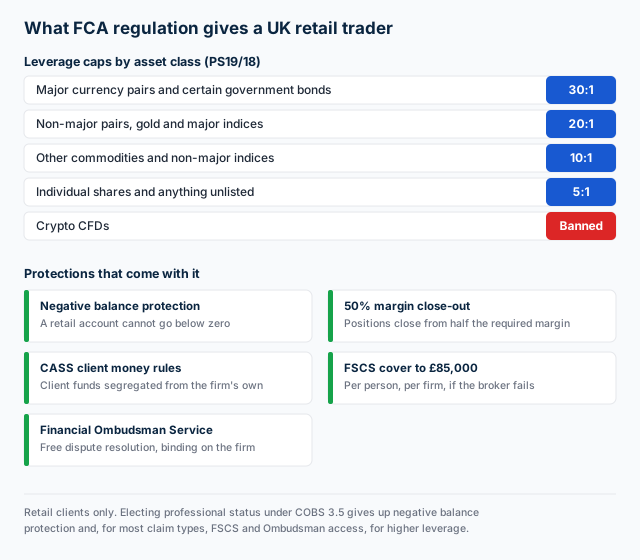
In my view, the diagram makes the trade-off clear: it sets the PS19/18 leverage caps by asset class against the protections that come with retail status: negative balance protection, the 50% close-out, CASS segregation, FSCS cover to £85,000 and access to the Financial Ombudsman Service.
PS19/18 also requires margin close-out at 50% of the margin needed to hold your open positions, mandatory negative balance protection for retail clients, a standardised risk warning that states the firm’s own percentage of losing retail accounts, and a ban on monetary and non-monetary inducements such as deposit bonuses and rebate promotions.
The caps are identical at every FCA broker and step down by asset class. How they apply to share, index and commodity contracts is covered across our CFD trading section. A broker advertising “flexible leverage up to 500:1” to UK retail clients is describing either its professional tier or its offshore entity. The distinction matters and is covered below.
Client money and how CASS segregation works
Client money at an FCA broker must be held under the FCA’s Client Assets Sourcebook (CASS 7): your funds sit in segregated client bank accounts, held on statutory trust, separate from the firm’s own money, with client-money reconciliations performed regularly. Segregation stops your deposit being used to run the broker’s business or being claimed by its creditors.
This is not a guarantee against every failure mode. If a firm collapses and a shortfall emerges in the client money pool, the costs of distributing that pool can reduce what comes back. That is the gap the FSCS exists to fill.
FSCS compensation and the £85,000 limit
The Financial Services Compensation Scheme protects up to £85,000 per person, per authorised firm, if an FCA-authorised broker fails owing you money, for example a client-money shortfall discovered in insolvency (source: fscs.org.uk, checked July 2026).
Two boundaries worth knowing. First, the FSCS covers firm failure, never trading losses: lose £20,000 on a GBP/USD position and no compensation scheme anywhere reimburses it. Second, cover attaches to the UK-authorised entity. Sign up through the same brand’s Seychelles or Bahamas entity and the £85,000 protection does not follow you.
The £120,000 figure is a deposit limit, not an investment one
You will see £120,000 quoted for the FSCS, including on some brokers’ own compliance pages, and it does not apply to a trading account. The deposit protection limit rose from £85,000 to £120,000 on 1 December 2025 under PRA policy statement PS24/25, and temporary high balances rose from £1m to £1.4m at the same time. That limit covers savings held with UK-authorised banks, building societies and credit unions.
Protection for investments, and for client money held with an FCA-authorised broker, remains £85,000 per person, per firm. Neither change touched CFD client money or investment business, and the FSCS says so explicitly: only the deposits and savings limit increased (sources: FSCS investments and PRA PS24/25, both checked 29 July 2026).
One more trap on the same theme: the limit is per firm, not per brand. Two brands sharing one FCA authorisation share one £85,000 limit between them, which is the position for Forex.com and City Index, both trading names of StoneX Financial Ltd.
The Financial Ombudsman Service as your dispute path
The Financial Ombudsman Service is the free statutory dispute body for complaints against FCA-authorised firms. If a broker mistreats you, the path runs:
- Complain to the broker in writing first. It must send a final response through its internal complaints process, normally within 8 weeks.
- No response or a poor one? Refer the complaint to the FOS at financial-ombudsman.org.uk within 6 months of the final response. Referring costs you nothing; the firm pays the case fees.
- The FOS investigates and issues a decision. If you accept it, the decision binds the firm.
The FOS can make a binding money award, and it raises the maximum each April. For complaints referred on or after 1 April 2026, the limit is £455,000 where the act or omission happened on or after 1 April 2019, and £205,000 where it happened before that date (financial-ombudsman.org.uk, checked 15 July 2026). The figure rises again each April, so confirm the current limit at the FOS site before relying on it. We confirm FCA authorisation, and with it FOS coverage, before listing any broker on this site.
How to verify a broker on the FCA Financial Services Register
It takes about two minutes. Here is the worked example with Pepperstone, one of the top-ranked brokers in our 2026 testing.
- Open the FCA Financial Services Register at register.fca.org.uk.
- Search the firm reference number (FRN) from the broker’s website footer or legal documents. For Pepperstone that is 684312.
- Check the result: the firm is Pepperstone Limited, status Authorised. The entity name should match the one named in the terms and Key Information Document you were given, exactly.
- Open the firm’s record and confirm its permissions cover the products it sells to retail clients, such as dealing in contracts for difference and rolling spot forex.
- Cross-check the entity, not just the brand. Large brands run several companies, and the register also lists clone-firm warnings. A fraudster borrowing a real FRN is the commonest trick. Our Pepperstone review shows how we separate the UK entity from the group’s offshore arms.
If the FRN on a broker’s website returns nothing on the register, or returns a different company, stop. That mismatch is the single most reliable scam tell in this market. We run this check on every broker before listing, and the process is documented in our review methodology and in why you can trust this site.
The crypto-derivatives ban for retail clients
Since 6 January 2021, under FCA Policy Statement PS20/10, FCA-authorised firms cannot sell, market or distribute derivatives referencing cryptoassets, including crypto CFDs, or crypto exchange-traded notes to retail consumers. There is no leverage tier for crypto in the UK; the product is simply not available to retail clients through regulated firms.
Any platform offering crypto CFDs to a UK retail trader is operating outside the FCA perimeter. None of the protections on this page, segregation, FSCS or FOS, apply there.
Professional client reclassification and the 500 to 1 offshore pitch
The FCA’s COBS 3.5 rules allow a request for elective professional status, opting out of retail protections. To qualify, you must pass a qualitative test, where the firm assesses your expertise, plus two of three quantitative criteria: an average of 10 significantly sized trades per quarter over the last four quarters, a financial instrument portfolio exceeding €500,000 or the sterling equivalent, and at least one year in a professional financial-sector role requiring knowledge of the products. I would say that is a high bar, and it is there for a reason.
Qualify, and the leverage caps no longer bind, but negative balance protection and the standardised risk warnings go with them. The trade is real: higher leverage against most of the retail safety net. Most traders who can qualify still should not.
In my opinion, the offshore route is worse. Search any large broker’s name and you will find a version offering 500:1 with no test at all, the same brand under a different company, usually licensed in the Seychelles, Vanuatu or the Bahamas. Outside the FCA perimeter there is no CASS segregation, no FSCS and no FOS; recourse runs through that jurisdiction’s courts. The platform looks identical, the entity behind it is not, which is why our platform comparisons only cover what each broker’s UK entity actually offers. This site reviews UK-authorised entities only; every broker in our reviews holds current FCA authorisation.
Regulation is the frame the rest of this material sits inside. What the caps do to a single position is on what is leverage in forex trading?, the collateral side is on CFD margin guide UK, and our margin calculator applies the right cap to a size you enter. For the wider picture, start at our education hub.
Our reviews are reader-supported. We may receive payment when you click a link to a partner site. Learn how we make money.
FAQs
Is forex trading legal in the UK?
Can I lose more than my deposit with an FCA broker?
What does the FSCS actually cover?
How do I check if a broker is FCA regulated?
Are crypto CFDs legal in the UK?
Should I use an offshore broker to get 500:1 leverage?
Related pages
About the author

Justin Grossbard is the co-founder and CEO at CompareForexBrokers. He has traded forex since 1998, leads UK broker research and has personally reviewed every FCA-regulated broker on this site. His work has appeared in Forbes, Kiplinger and Finance Magnates, and he holds a Bachelor of Commerce (Honours) and a Master of Marketing.