
Risk warning: CFDs are complex instruments and come with a high risk of losing money rapidly due to leverage. The majority of retail investor accounts lose money when trading CFDs. You should consider whether you understand how CFDs work and whether you can afford to take the high risk of losing your money. This page is general information, not financial advice. Advertiser disclosure.
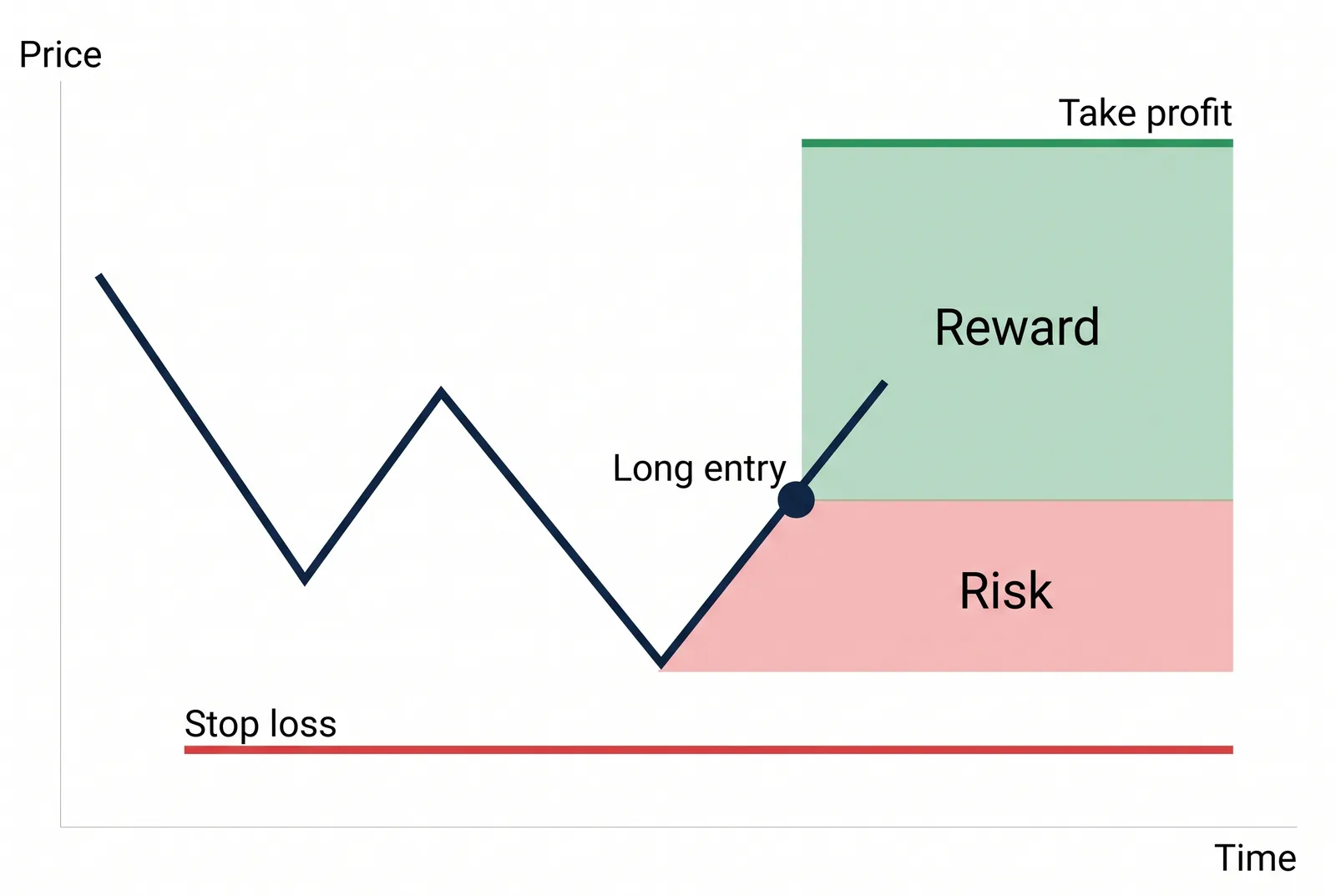
A stop-loss order automatically closes a position when price hits a set level, capping the loss on a trade. I consider it the core risk-control tool for any forex trader: it defines the risk before entry. The stop locks in your loss in advance, rather than leaving the position to the FCA close-out backstop.
The table below sizes your trade on a £10,000 account risking one percent, using GBP/USD pip values at a rate of 1.3592 (28 August 2026).
| Item | Value |
|---|---|
| Account balance | £10,000 |
| Risk per trade | 1 percent, so £100 |
| Pip value, one standard lot (100,000 units) | £7.36 |
| Pip value, one mini lot (10,000 units) | £0.74 |
| Stop room at £100 risk, standard lot | 13.6 pips |
| Stop room at £100 risk, mini lot | 136 pips |
How a stop-loss works
You place a stop below a long entry or above a short entry, and the broker closes the position if price hits it. A standard stop fills at the next available price; in a fast or gapping market, that fill can be worse than the set level, which is slippage. Some FCA-regulated brokers offer a guaranteed stop for a fee, which fills exactly at the level regardless of gaps. For a scalper, a standard stop is usually enough, but for a swing trader holding over weekends, I rate the guaranteed stop as the safer choice.
What a guaranteed stop costs
A guaranteed stop-loss order (GSLO) turns gap risk into a fixed price. The broker fills your exit exactly at the level you set, through any weekend gap or fast market, and charges a premium for taking on that slippage risk. A standard stop stays free but fills at the next available price.
| Stop type | Fill in a gap | Cost |
|---|---|---|
| Standard stop | Next available price, so it can slip | Free |
| Guaranteed stop | Exactly at your level | Premium, at some brokers charged only if it triggers |
I count three FCA-regulated brokers that offer guaranteed stops, and each one prices the premium differently.
| Broker | Guaranteed stop | How the premium works |
|---|---|---|
| IG Markets | Yes | You set a premium when you place the order, charged only if the guaranteed stop is triggered |
| CMC Markets | Yes | A premium applies when the guaranteed stop is triggered, at a rate that varies by market |
| Plus500 | Yes | The cost is applied as a wider spread on instruments where a guaranteed stop is enabled |



Exact premium rates and the list of eligible markets vary by firm and change over time, so confirm the current figure on each broker’s own UK site before relying on it (checked July 2026). A guaranteed stop earns its premium around scheduled news and weekend gaps. On a calm intraday trade, a standard stop would have filled at or near your level anyway, so the premium is wasted.
Sizing a stop to a GBP risk
I always start from risk, not from a chart guess. Decide the pounds you will accept as a loss, say one percent of a £10,000 account, which is £100. On GBP/USD each pip is worth US$10 per standard lot, £7.36 once converted to sterling at a rate of 1.3592 (28 August 2026), and £0.74 on a mini lot. Divide the £100 risk by the pip value and you have the room the trade allows: £100 at £7.36 a pip is a tight 13.6-pip stop on a standard lot, while £100 at £0.74 a pip lets a mini lot breathe over 136 pips. Work it the other way when the chart fixes the stop first. A 25-pip stop that risks £100 works out at 0.54 of a standard lot, because 25 pips at £7.36 a pip is £183.93 of risk per full lot. Sizing this way keeps every loss to a fixed pound amount, whatever the pair. Our forex position size calculator does that division at current exchange rates and rounds the size down to the 0.01-lot step brokers accept. The pip value also moves with the spread you are charged, so compare tight, transparent pricing in the lowest spread brokers guide. Our team tests broker platforms on live, GBP-funded accounts.
Position Size Calculator
Rates as of Fri 28 Aug 2026, 5pm New York close
0.54standard lots
Your 25-pip stop is 37% of GBP/USD's average daily range, measured at 66.8 pips over the 20 trading days to 25 Aug 2026. The same £100.00 risk with a stop the full width of that range sizes to 0.20 lots.
Range is the average of daily high-to-low over the stated window, computed from our dataset of daily bars (5pm New York day boundary). Metals are excluded: no standard pip convention exists for them. Sizing is rounded down so the risk figure is never exceeded.
- Risk amount (1% of £10,000)£100.00
- Pip value at 1.00 lot£7.36
- Stop distance25 pips
Sizing a 25-pip GBP/USD stop on a £10,000 account, 28 August 2026. Risking one percent puts £100.00 on the trade. One pip on a standard lot is £7.36 at a GBP/USD rate of 1.3592, so a 25-pip stop costs £183.93 per full lot. Dividing the risk by that figure and rounding down to the 0.01-lot step brokers accept gives 0.54 standard lots, 54,000 units, which puts £99.32 at risk if the stop fills.
Trailing stops and other stop types
A trailing stop moves with the price once a trade is in profit, locking in gains while leaving the position open, unlike a fixed stop that stays at one level. It suits trending markets; a fixed stop suits a defined support or resistance level. Most trading platforms, including MT4, support trailing stops natively. To check the pound outcome of any entry, stop and exit combination before you place the trade, use our profit and loss calculator.
Stops versus the FCA backstops
A stop is your chosen risk level; the FCA 50% margin close-out and negative balance protection are last-resort backstops. Close-out only acts once account equity falls to half the required margin, which is far deeper than a sensible per-trade stop. In my view, relying on close-out instead of a stop means accepting a much larger loss before anything intervenes. Setting a stop at the same time you open a trade is built into most modern trading platforms.
Common mistakes
I see traders make these mistakes often: setting a stop by round number rather than by risk produces position sizes that breach your intended pound loss. Moving a stop further away to avoid being closed out turns a small planned loss into a large one. Trading without a stop and leaning on the close-out rule, covered in the drawdown guide, is the most expensive habit of all. Position sizing, the stop in front of it and the margin behind it all sit within the wider trading education hub.
A stop is what keeps an account away from the close-out rather than reliant on it. The protections behind that floor, from negative balance protection to FSCS cover, are compared across the field on our FCA-regulated broker rankings, and drawdown in forex trading UK covers what happens when stops are set too wide.
Our reviews are reader-supported. We may receive payment when you click a link to a partner site. Learn how we make money.
FAQs
What is a stop-loss in forex?
How do I set a stop-loss size?
What is a guaranteed stop-loss?
What is a trailing stop?
Does a stop-loss cost anything?
Related pages
About the author

Justin Grossbard is the co-founder and CEO at CompareForexBrokers. He has traded forex since 1998, leads UK broker research and has personally reviewed every FCA-regulated broker on this site. His work has appeared in Forbes, Kiplinger and Finance Magnates, and he holds a Bachelor of Commerce (Honours) and a Master of Marketing.