
Risk warning: CFDs are complex instruments and come with a high risk of losing money rapidly due to leverage. The majority of retail investor accounts lose money when trading CFDs. You should consider whether you understand how CFDs work and whether you can afford to take the high risk of losing your money. This page is general information, not financial advice. Advertiser disclosure.
I rate IG Markets and CMC Markets as the top index CFD brokers for UK traders on FTSE 100 and US 500 cost, with Pepperstone close behind on raw pricing. I see a 20:1 FCA retail leverage cap on major equity indices and 10:1 on non-major ones, which governs how much margin you need. Every broker below is FCA-regulated with FSCS cover.
Which broker is best for index CFDs in the UK?
I consider IG Markets the best index CFD broker in the UK, with FTSE 100 spreads from 1 point advertised across the deepest index range here. CMC Markets follows on its wide index and sector menu, and Pepperstone prices the US 500 from 0.4 points with no commission. For you, major-index retail leverage is capped at 20:1, so your margin is limited.
Our seven picks for index CFDs, ranked:
- IG Markets: FTSE 100 from 1 point advertised, deepest range.
- CMC Markets: US 500 from 0.5 points, wide sector menu.
- Pepperstone: US 500 from 0.4 points, no commission.
- XTB: major and minor indices plus ETFs on xStation.
- Vantage: raw index pricing on the majors.
- Eightcap: raw index pricing, traded from TradingView.
- Forex.com: FTSE 100 from 1 point, spread-only.
The order reflects index-CFD cost and range, not each broker’s overall score.
Comparison table: index CFD brokers
For me, the cost that matters is the GBP-per-point spread on the indices you trade, usually the FTSE 100, US 500 and Germany 40. Several brokers charge no separate commission on index CFDs, so the spread carries the full cost; for you, that makes the spread your main cost. I take the figures from advertised minimum spreads in points on each broker’s own site (see how we rate brokers). With the 20:1 FCA cap on major indices, a £10,000 position needs £500 of margin, which our forex margin calculator returns for any index or cap.
| Rank | Broker | Index range | FTSE 100 (points) | US 500 (points) | Germany 40 (points) | Visit broker | More details |
|---|---|---|---|---|---|---|---|
| 1 |  IG Markets#1 Top index CFD pick IG Markets#1 Top index CFD pick | FTSE 100, US 500, Germany 40, global | from 1 | from 0.4 | from 1.2 | Visit IG Markets | |
| |||||||
| 2 |  CMC Markets CMC Markets | Wide index and sector range | from 1 | from 0.5 | from 1.2 | Visit CMC Markets | |
| |||||||
| 3 |  Pepperstone Pepperstone | Major global indices | - | from 0.4 | - | Visit Pepperstone | |
| |||||||
| 4 |  XTB XTB | Major and minor indices, ETFs | from 1.4 | from 0.4 | from 0.9 | Visit XTB | |
| |||||||
| 5 |  Vantage Vantage | Major global indices | - | - | - | Visit Vantage | |
| |||||||
| 6 |  Eightcap Eightcap | Major global indices | see note | - | from 1.5 | Visit Eightcap | |
| |||||||
| 7 |  Forex.com Forex.com | Major global indices | from 1 | from 0.4 | from 1 | Visit Forex.com | |
| |||||||
In my view, a dash means we could not confirm an advertised minimum on the broker’s UK site. I note that Eightcap advertises its UK100 minimum as “from 12” in the units shown on its own indices page, which are not directly comparable to the point figures above. For you, that means the comparison is not straightforward.
Advertised minimum index spreads from each broker’s UK site, captured 10 July 2026. Minimums apply in liquid hours; spreads widen outside them. Re-verify on the broker’s current UK disclosure before relying on any figure.
All seven brokers are FCA-authorised with FSCS cover up to £85,000 per eligible person and Financial Ombudsman Service access. They all apply the FCA’s PS19/18 caps: 20:1 on major indices, 10:1 on non-major and sector indices, plus negative balance protection and a 50% margin close-out. That protection matters to me, and it should to you too.
The index spreads above are a desk-based assessment of each broker’s advertised UK pricing, not spreads we captured on a live account. Every FCA broker here is also assessed on demo and live accounts under our published process; the all-in test that adds any commission back to the spread is set out in the lowest spread brokers guide.
1. IG Markets: deepest index range at 1-point FTSE spreads

CFDs carry high risk. Retail leverage is FCA-capped.
- Average spread
- 1.13 pips avg, IG Trading (spread-only), tested July 2026
- Trading platforms
- IG platform, MT4, ProRealTime
- Minimum deposit
- None published
- Regulation
- IG Markets Limited (FRN 195355)
◎ Standout: the deepest index and sector menu here, quoted spread-only with near-24-hour weekday dealing on the majors.
Why higher here? Index CFD Fit weights index range and index pricing, which lifts IG Markets above its #9 sitewide position. See the ranking method ↓
Why we recommend IG Markets
IG Markets Limited advertises the joint-tightest FTSE 100 spread in this set, from 1 point, across the deepest index menu: majors, minors and sector indices in cash and futures form. Spread-only pricing keeps the maths simple, with no separate commission on index CFDs. Our UK review scored it 80 out of 100.
The trade-off is FX pricing that raw-account rivals beat and a platform set without MT5 or cTrader. Index-first traders who value range and a long FCA record, trading since 1974, will not mind. Confirm the current account minimum on IG's UK site before funding.
Pros & cons
- FTSE 100 from 1 point (advertised)
- Deepest index and sector range in the set
- Cash and futures index forms
- Spread-only pricing rather than a raw account
- No MT5 or cTrader
- Advertised minimums apply only in liquid hours
2. CMC Markets: widest index and sector menu

CFDs carry high risk. Retail leverage is FCA-capped.
- Average spread
- 0.65 pips avg, FX Active (raw), tested July 2026
- Trading platforms
- Next Generation, MT4
- Minimum deposit
- £0
- Regulation
- CMC Markets UK plc (FRN 173730)
◎ Standout: one of the widest index and sector CFD menus here on the proprietary Next Generation platform.
Why higher here? Index CFD Fit weights index range and index pricing, which lifts CMC Markets above its #6 sitewide position. See the ranking method ↓
Why we recommend CMC Markets
CMC Markets UK plc lists one of the widest index and sector CFD ranges in this set on its Next Generation platform, spread-only with no separate commission on index CFDs. The firm has traded since 1989 and its parent is listed on the London Stock Exchange. Our UK review scored it 82 out of 100.
The market-maker spread carries the whole cost, and its advertised US 500 minimum of 0.5 points sits just behind the 0.4-point brokers. For traders who value one deep multi-asset platform over the last fraction of a point, CMC is the stronger fit.
Pros & cons
- Wide index and sector CFD range
- Strong proprietary charting
- LSE-listed parent as a structural signal
- Market-maker spread carries the cost
- US 500 from 0.5 sits behind the 0.4-point brokers
- No MT5 or cTrader
3. Pepperstone: US 500 from 0.4 points on four platforms

CFDs carry high risk. Retail leverage is FCA-capped.
- Average spread
- 0.1 pips avg, Razor (raw), tested July 2026
- Trading platforms
- MT4, MT5, cTrader, TradingView
- Minimum deposit
- £10
- Regulation
- Pepperstone Limited (FRN 684312)
◎ Standout: index CFDs with no separate commission across MT4, MT5, cTrader and TradingView.
Why we recommend Pepperstone
Pepperstone Limited pairs raw index pricing with the widest platform choice here, running MT4, MT5, cTrader and TradingView on one FCA account. Its advertised US 500 spread starts from 0.4 points with no separate commission on index CFDs. Our UK review scored it 90 out of 100, the highest in this set.
It publishes no advertised FTSE 100 or Germany 40 minimum, quoting those live in-platform, and its index menu is narrower than IG's or CMC's. Traders who want raw pricing and platform choice over the deepest index range will find it hard to beat.
Pros & cons
- US 500 from 0.4 points (advertised)
- No separate commission on index CFDs
- Four platforms on one account
- No advertised FTSE 100 or Germany 40 minimum, quoted live in-platform
- Narrower index menu than IG or CMC
- Raw pricing suits active traders more than occasional ones
4. XTB: index and ETF breadth on xStation
CFDs carry high risk. Retail leverage is FCA-capped.
- Average spread
- 0.92 pips avg, Standard (spread-only), tested July 2026
- Trading platforms
- xStation 5
- Minimum deposit
- £0
- Regulation
- XTB Limited (FRN 522157)
◎ Standout: the tightest advertised Germany 40 spread here, from 0.9 points, with ETF CFDs alongside indices.
Why higher here? Index CFD Fit weights index range and index pricing, which lifts XTB above its #14 sitewide position. See the ranking method ↓
Why we recommend XTB
XTB Limited runs everything through xStation 5 and lists one of the larger index and ETF CFD ranges of the FCA set. Its advertised Germany 40 minimum, from 0.9 points, is the tightest here, and its US 500 matches the 0.4-point leaders. Our UK review scored it 77 out of 100.
The trade-offs are an advertised FTSE 100 minimum of 1.4 points, the widest in this table, and no MetaTrader support. For traders happy on a single strong proprietary platform, the index and ETF breadth is the draw.
Pros & cons
- Germany 40 from 0.9 points, tightest advertised here
- ETF CFDs alongside indices
- US 500 from 0.4 points (advertised)
- FTSE 100 from 1.4 points is the widest advertised figure in the set
- No MetaTrader or cTrader
- Single-platform lock-in on xStation
5. Vantage: raw index pricing on the majors

CFDs carry high risk. Retail leverage is FCA-capped.
- Average spread
- 0.08 pips avg, Raw ECN, tested July 2026
- Trading platforms
- MT4, MT5, TradingView, proprietary
- Minimum deposit
- £50
- Regulation
- Vantage Global Prime LLP (FRN 590299)
◎ Standout: a raw-account structure on the major global indices across MT4, MT5 and TradingView.
Why higher here? Index CFD Fit weights index range and index pricing, which lifts Vantage above its #8 sitewide position. See the ranking method ↓
Why we recommend Vantage
Vantage Global Prime LLP offers a raw-account structure on the major global indices across MT4, MT5, TradingView and its own platform. Our UK review scored it 82 out of 100.
It publishes no advertised index minimum, quoting spreads live in-platform, so it cannot be benchmarked from a static disclosure the way IG or XTB can. Our tested capture covers Vantage's FX pairs, not its indices, so check the live in-platform spread on the index you trade before relying on the raw-pricing claim.
Pros & cons
- Raw-account pricing on the major indices
- MT4, MT5 and TradingView on one account
- Scored 82 in our UK review
- Publishes no advertised index minimum to benchmark
- Index menu narrower than IG or CMC
- No tested index capture; index spreads are quoted live in-platform
6. Eightcap: raw index pricing on TradingView
CFDs carry high risk. Retail leverage is FCA-capped.
- Average spread
- 0.1 pips avg, Raw, tested July 2026
- Trading platforms
- TradingView
- Minimum deposit
- £100
- Regulation
- Eightcap Group Ltd (FRN 921296)
◎ Standout: an advertised Germany 40 minimum from 1.5 points on its raw account, traded from TradingView charts.
Why higher here? Index CFD Fit weights index range and index pricing, which lifts Eightcap above its #20 sitewide position. See the ranking method ↓
Why we recommend Eightcap
Eightcap Group Ltd offers raw-account index pricing with an advertised Germany 40 minimum from 1.5 points. TradingView is the only platform it markets to UK clients, so the raw account and the charts are the same decision here rather than two. Our UK review scored it 72 out of 100.
Its UK100 figure is quoted in the units shown on its own indices page, which are not directly comparable to the point spreads in the table above, and it publishes no US 500 minimum. Confirm the quoting unit and current spreads on Eightcap's UK site before relying on either.
Pros & cons
- Germany 40 from 1.5 points (advertised)
- Raw-account pricing, traded from TradingView
- Scored 72 in our UK review
- Quotes its UK100 minimum in units not comparable to the point figures here
- No advertised US 500 minimum published
- Index menu narrower than IG or CMC
7. Forex.com: spread-only match for the majors

CFDs carry high risk. Retail leverage is FCA-capped.
- Average spread
- 1 pips avg, UK Standard (spread-only), tested July 2026
- Trading platforms
- MT4, TradingView, proprietary
- Minimum deposit
- £100
- Regulation
- StoneX Financial Ltd (FRN 446717)
◎ Standout: advertised FTSE 100 and US 500 minimums that match IG's on a simpler spread-only account.
Why we recommend Forex.com
Forex.com, a trading name of StoneX Financial Ltd, matches IG's advertised FTSE 100 and US 500 minimums, from 1 point and 0.4 points, on a simpler spread-only account across MT4, TradingView and its own software. Our UK review scored it 83 out of 100.
Its index menu is narrower than IG's or CMC's, and it is the same FCA firm as City Index, StoneX Financial Ltd, so running an account with both spreads nothing at all. For a spread-only match on the majors, it does the job.
Pros & cons
- FTSE 100 from 1 point (advertised)
- US 500 from 0.4 points, matching the leaders
- MT4 and TradingView on one account
- Narrower index menu than IG or CMC
- Sits within the same StoneX group as City Index, so splitting between the two adds little diversification
- Spread-only rather than a raw account
What an index CFD tracks
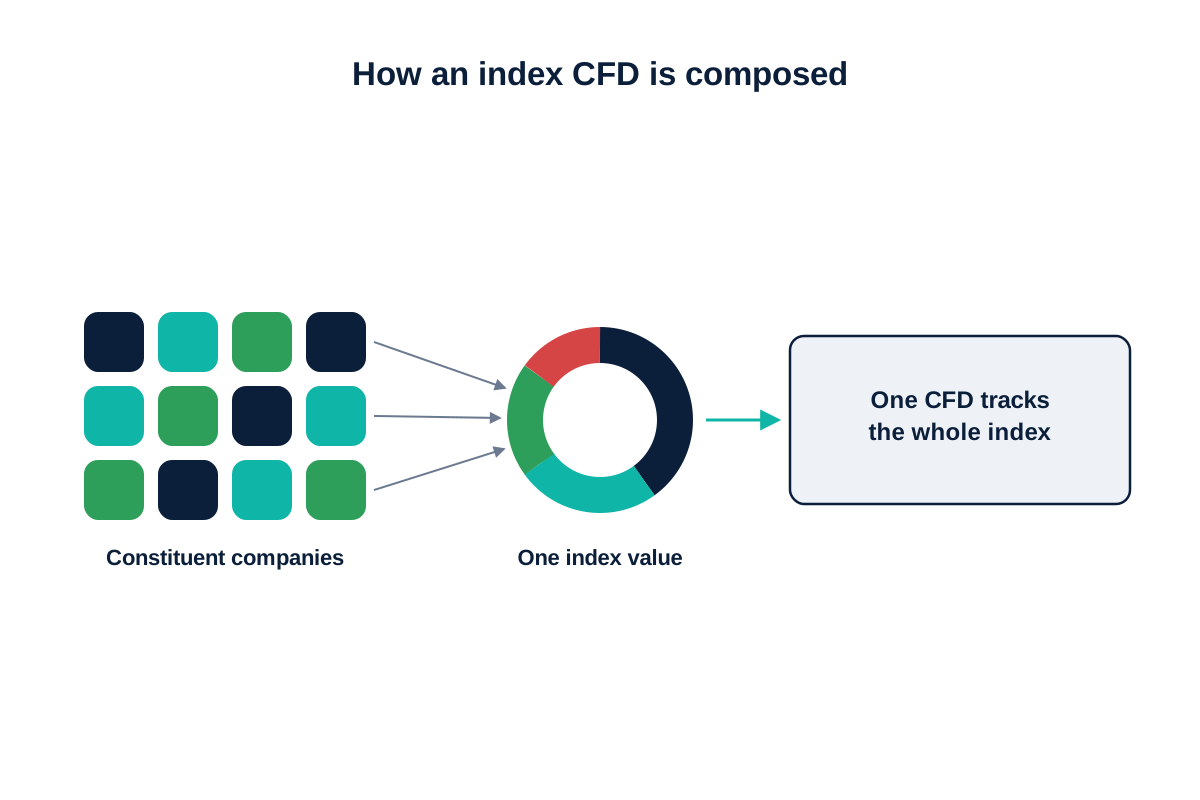
An index CFD tracks the price of a stock index, such as the FTSE 100 or US 500, without you owning the underlying shares. It gives you leveraged exposure to the index level, so your position profits or loses as the index rises or falls. In my view, that lets you take a view on a whole market in one position, rather than buying each constituent share. Index levels also respond to central-bank policy, so how interest rates affect forex shapes where an index trades, affecting your positions.
Cash vs futures index CFDs
Index CFDs come in two forms. A cash or spot index CFD tracks the current index level and carries an overnight financing charge on positions held past the daily cut-off. The futures form tracks a dated futures contract, has no daily financing charge but a wider spread, and expires on a set date. In my opinion, if you scalp or day trade, you will likely prefer cash indices for the tighter spread; if you hold for weeks, futures often work better to avoid nightly financing.
FCA leverage caps on index CFDs
The FCA splits index CFDs into two retail leverage bands under PS19/18. Major equity indices, including the FTSE 100, US 500, Germany 40 and US Tech 100, are capped at 20:1, so your £1,000 margin controls up to £20,000 of exposure. Non-major and sector indices are capped at 10:1. I rely on the FCA’s Handbook list of major indices under PS19/18, not a broker’s marketing, to know which cap applies. Negative balance protection and the 50% margin close-out rule apply to all your retail index positions, protecting your account. For the mechanics behind those margin multiples, see what is leverage.
CFD Margin Calculator
FCA CFD product intervention rules, COBS 22.5 (PS19/18), permanent since 1 August 2019
£500.00initial margin required
£10,000.00 of exposure needs £500.00 of initial margin at the FCA 20:1 cap.
- Position value£10,000.00
- FCA leverage cap for major stock indices20:1
- Margin rate5%
- Close-out floor (50% of margin)£250.00
I also rate Tickmill as a low-commission option for index CFDs; see the Tickmill review. For you, that could lower your trading costs.
Compare brokers by the factor that decides it
In my experience, different traders rank on different things. Start from the factor that decides it for you. For you, that means focusing on what matters most.

Start with the overall ranking
Our main UK list scores every FCA-regulated broker on cost and execution.

What you trade decides it
I note that each market carries its own FCA leverage cap, so the by-asset pages rank brokers per instrument. For you, that means you can see the best broker for each index.
Cost decides it
In my view, the same trade costs different amounts on different account types, so these lists rank on the all-in figure. For you, that helps you compare total cost.

The platform decides it
Pick your trading software first, then compare the brokers that carry it.
Our reviews are reader-supported. We may receive payment when you click a link to a partner site. Learn how we make money.
FAQs
Is IG Markets the best index CFD broker in the UK?
What leverage applies to index CFDs in the UK?
What is the difference between cash and futures index CFDs?
Can I trade the FTSE 100 24 hours a day?
Are index CFD profits taxed in the UK?
What is the cheapest index to trade?
Related pages
About the author

Justin Grossbard is the co-founder and CEO at CompareForexBrokers. He has traded forex since 1998, leads UK broker research and has personally reviewed every FCA-regulated broker on this site. His work has appeared in Forbes, Kiplinger and Finance Magnates, and he holds a Bachelor of Commerce (Honours) and a Master of Marketing.