
Risk warning: CFDs are complex instruments and come with a high risk of losing money rapidly due to leverage. The majority of retail investor accounts lose money when trading CFDs. You should consider whether you understand how CFDs work and whether you can afford to take the high risk of losing your money. This page is general information, not financial advice. Advertiser disclosure.
In my experience the 30:1 cap binds far less often than new traders expect, because what limits a sensible account is risk tolerance, not the regulation. Risking 1% of a £5,000 account on a 30-pip GBP/USD stop puts roughly £22,000 of exposure on, which ties up about £740 of margin at the cap. That same account is allowed £150,000 of exposure. The cap only starts to bite once position sizing has already drifted well past what the balance can absorb, which is the behaviour the FCA was aiming at. The one route above it is elective professional status under COBS 3.5, and it costs negative balance protection and FSCS access to get there.
Summary of leverage caps for UK retail traders
Under the FCA’s PS19/18 product-intervention rules, retail leverage is capped at 30:1 on major currency pairs and on relevant sovereign debt (government bonds issued by the UK, a eurozone member state, the US, Japan, Canada or Switzerland), 20:1 on non-major pairs, gold and major indices, 10:1 on other commodities and non-major indices, and 5:1 on individual shares and on any asset the rules do not otherwise list, which includes government bonds outside that group. Crypto CFDs are banned for retail clients under PS20/10.
In my view, three protections sit behind the caps. Positions start closing when account equity falls to 50% of the required margin. Negative balance protection stops a retail account going below zero. And every firm must display its own percentage of losing retail accounts.
Higher ratios exist only for elective professional clients, who give up those protections to get them. The full asset-by-asset detail sits on the CFD pillar.
What is leverage in forex?
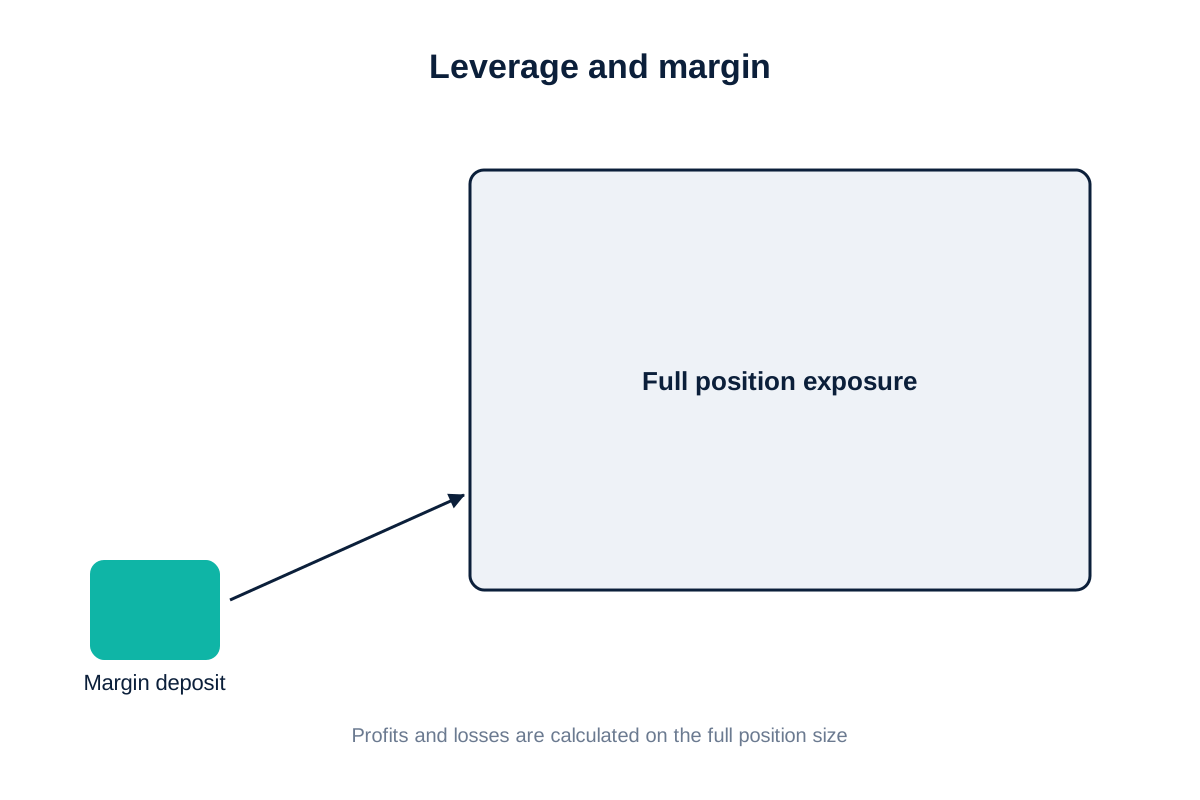
Leverage is expressed as a ratio, such as 30:1, meaning your exposure can be thirty times the margin you post. Trade a £30,000 position on EUR/USD at 30:1 and you commit about £1,000 in margin. A 1% move in your favour returns roughly £300 on that £1,000, and a 1% move against you costs roughly the same, so the deposit, not the position size, is the risk you feel first.
Leverage versus margin
Leverage and margin are the same relationship read from opposite ends. Leverage is the multiple of exposure to cash. Margin is the cash fraction the broker holds. I would put it as: at 30:1, margin is 1/30 of the position, which is 3.33%.
Initial margin = position size divided by leverage ratio
A £30,000 position at 30:1 needs £1,000 of margin. The same position at 20:1 needs £1,500. In my view, the cap changes the deposit, never the risk of the £30,000 exposure itself.
Margin Calculator
Rates as of Fri 28 Aug 2026, 5pm New York close
£1,000.00margin required
- Notional value£30,000.00
- FCA leverage cap for major currency pairs30:1
- Margin rate3.33%
- Close-out floor (50% of margin)£500.00
Margin on a 0.30-lot GBP/USD position, 28 August 2026. That size is £30,000 of exposure at a GBP/USD rate of 1.3592. At the FCA’s 30:1 major-pair cap the margin rate is 3.33%, so initial margin is £1,000.00, and the 50% close-out floor sits at £500.00 of equity.
How the FCA’s caps apply across asset classes
The FCA’s retail leverage caps under PS19/18 run from 30:1 on major currency pairs down to 5:1 on individual shares, with bands in between for non-major pairs, gold, indices and commodities. Government bonds sit at 30:1 only where they count as relevant sovereign debt, the FCA’s deliberate divergence from ESMA’s lower reference; bonds outside that defined group fall to 5:1. Offshore brokers may advertise 100:1 or 500:1, but those figures are not available to UK retail clients, so I would treat them as a sign the entity is not FCA-regulated.
| Asset class | FCA retail leverage cap |
|---|---|
| Major currency pairs | 30:1 |
| Non-major currency pairs | 20:1 |
| Gold | 20:1 |
| Major stock indices | 20:1 |
| Other commodities and non-major indices | 10:1 |
| Government bonds from the UK, eurozone, US, Japan, Canada or Switzerland | 30:1 |
| Individual shares, and any asset not listed above | 5:1 |
| Crypto CFDs | Banned for retail clients |
Source: FCA PS19/18, in force 1 August 2019, and the FCA’s statement on ESMA’s Opinion covering the 30:1 government-bond tier (fca.org.uk, checked July 2026).
CFD leverage caps run lower across most asset classes than the forex-majors ceiling. The index CFD brokers guide works through the major-versus-minor split on equity indices, where the 20:1 and 10:1 bands diverge.
How margin works across initial margin, close-out and free margin
Initial margin opens the position, set by the FCA cap for the instrument. After that, the account is marked to market tick by tick, so your equity is the balance plus or minus open profit and loss.
Margin close-out at 50%
FCA rules require the broker to start closing positions when equity falls to 50% of the initial margin used. Post £1,000 of margin and liquidation begins once equity hits £500. It is a backstop, not a stop-loss. By the time it acts the account has already lost half its committed margin, which is why a stop-loss order should act first. Negative balance protection then guarantees the account cannot finish below zero, even if prices gap straight through the close-out level.
What free margin means on your platform
Platforms such as MT4 show equity, margin and free margin side by side. Free margin is equity minus the margin locked into open positions, which is the room left for new trades or adverse moves. Traders who spend all their free margin on new positions leave the account one ordinary loss away from close-out. The margin explainer works through the full mechanics.
Retail versus elective professional clients
UK brokers can offer higher leverage to clients reclassified as elective professionals. The FCA caps apply to retail clients only. The exact professional ratio varies by firm and is not a figure to assume, so I would confirm it directly with the broker rather than relying on a number quoted elsewhere.
How to qualify under COBS 3.5
Under FCA COBS 3.5.3, the broker must assess your expertise, and you must normally meet at least two of three tests. First, you have carried out transactions of significant size on the relevant market at an average frequency of 10 per quarter over the previous four quarters. Second, your financial instrument portfolio, including cash deposits, exceeds €500,000. Third, you have worked for at least one year in a professional position in the financial sector that requires knowledge of the products. Some firms now frame the portfolio threshold in sterling, so check the current figure on the broker’s application. The broker must also tell you in writing which protections you give up.
Why professional status is not a free upgrade
Reclassifying strips the retail protections. The leverage caps, the 50% close-out backstop and negative balance protection no longer apply, and the standardised retail risk-warning regime falls away. Your access to the FSCS and the Financial Ombudsman Service can also change depending on how you are classified, so confirm your position before you agree. A trader who wants more exposure without the paperwork can usually get it more safely by trading a larger account at the retail cap than by signing away the backstops.
A worked GBP example at the retail cap
Deposit £1,000 and buy one mini lot of EUR/GBP, which is €10,000 of exposure, about £8,600 at an illustrative rate of 0.86. EUR/GBP counts as a major pair, so the 30:1 cap applies and initial margin is about £287. Because GBP is the quote currency, each pip is worth £1 on a mini lot, with no conversion needed. The rate and margin figure are illustrative, for July 2026. At 30:1 that same £8,600 position needs about £287 down, and the margin calculator returns the initial margin for any pair or cap.
| EUR/GBP move | Profit or loss | Account equity | Note |
|---|---|---|---|
| +50 pips | +£50 | £1,050 | 5% gain on the account |
| +100 pips | +£100 | £1,100 | |
| -50 pips | -£50 | £950 | |
| -100 pips | -£100 | £900 | 10% of the account on a 1.2% price move |
| -857 pips | -£857 | £143 | Equity near 50% of margin, close-out begins |
The same £1,000 could open three mini lots and triple every row, including the last. In my view, position size, not the leverage on offer, is the risk decision. Size it deliberately: trading calculators cover margin, pip value and position size in GBP.
Why the FCA capped leverage in the first place
Before the caps, UK CFD firms’ own disclosures showed most client accounts losing money. The FCA’s analysis around its 2016 consultation found that a large majority of sampled retail CFD clients lost money, on the order of 80%, with average annual losses in the low thousands of pounds (FCA CP16/40, 2016). ESMA imposed EU-wide temporary caps from 1 August 2018, and the FCA made them permanent for the UK under PS19/18 from 1 August 2019, diverging only on the government-bond tier. In my view, the logic is arithmetic, not paternalism. At 500:1 a 0.2% adverse move erases the margin, while at 30:1 the same move costs about 6% of it. Our team tests broker platforms and accounts, so we understand these mechanics. Offshore entities advertising 500:1 to UK residents sit outside FCA authorisation, FSCS cover and FOS access, so the leverage itself is the warning.
Comparing leverage between UK brokers
Every FCA-authorised broker offers the same retail caps. 30:1 is a ceiling set by the regulator, not a feature a firm can better. What differs is the elective-professional offer and how each firm handles margin close-out in fast markets. I recommend using our position size calculator to translate a leverage cap into an actual trade size for your account balance and risk. The table below names six FCA-authorised brokers with their UK entity and firm reference number, so you can confirm each on the FCA register.
| Broker | FCA entity (FRN) | Retail major-pair cap | Higher leverage |
|---|---|---|---|
| Pepperstone | Pepperstone Limited (684312) | 30:1 | Elective professional clients only |
| IG Markets | IG Markets Limited (195355) | 30:1 | Elective professional clients only |
| CMC Markets | CMC Markets UK plc (173730) | 30:1 | Elective professional clients only |
| XTB | XTB Limited (522157) | 30:1 | Elective professional clients only |
| Tickmill | Tickmill UK Ltd (717270) | 30:1 | Elective professional clients only |
| Plus500 | Plus500UK Ltd (509909) | 30:1 | Elective professional clients only |






All six run elective-professional accounts with higher leverage, but the exact ratio varies by firm and changes over time, so confirm it on the broker’s own UK application rather than relying on a figure quoted elsewhere. We have not verified individual professional-tier ratios for this table. There are no ratings or recommendations here. The top FCA-regulated forex brokers comparison ranks the field on cost and execution.
Common leverage mistakes UK traders make
Watch: how UK brokers compare on leverage. Every FCA-regulated firm applies the same 30:1 retail cap, so the differences sit in the elective-professional tiers covered above.
Confusing maximum leverage with required leverage
In my view, the 30:1 cap says what a trader may do, not what a trader should. Plenty of consistently profitable traders run effective leverage under 5:1.
Over-sizing relative to account equity
Sizing from the margin figure instead of the position figure puts far more than the intended pounds at risk. I would suggest deciding the pound loss you will accept first, then working back to the position size.
Ignoring overnight swap costs
Leverage multiplies financing as well as price exposure. A heavily leveraged position held for weeks can lose more to swaps than to the market itself. How brokers make money shows the mechanics.
Treating the close-out rule as a strategy
The 50% close-out and negative balance protection are crash barriers, not a plan. Hitting them means the position sizing already failed. Check how individual firms handle close-out in fast markets in our broker reviews.
Position sizing, the margin behind it and the stop that should sit in front all sit within the wider education hub.
Our reviews are reader-supported. We may receive payment when you click a link to a partner site. Learn how we make money.
FAQs
What leverage can I use trading forex in the UK?
Is high leverage a good idea?
What does 30 to 1 leverage mean?
Can I get higher leverage than 30:1 in the UK?
How do I get professional-client leverage in the UK?
Is 30:1 leverage enough to trade profitably?
Related pages
About the author

Justin Grossbard is the co-founder and CEO at CompareForexBrokers. He has traded forex since 1998, leads UK broker research and has personally reviewed every FCA-regulated broker on this site. His work has appeared in Forbes, Kiplinger and Finance Magnates, and he holds a Bachelor of Commerce (Honours) and a Master of Marketing.