
Risk warning: CFDs are complex instruments and come with a high risk of losing money rapidly due to leverage. The majority of retail investor accounts lose money when trading CFDs. You should consider whether you understand how CFDs work and whether you can afford to take the high risk of losing your money. This page is general information, not financial advice. Advertiser disclosure.
If you trade bond CFDs, I would start with CMC Markets and IG Markets. They carry the deepest treasury and bond CFD ranges for UK traders, covering UK gilts, US treasuries and German Bunds. Bond CFDs are a niche product, so few FCA brokers wrap government bonds as retail CFDs. Saxo, City Index and Admirals cover parts of the asset class, and Interactive Brokers offers underlying bond-market access as a different product. Every broker below holds FCA authorisation and carries FSCS cover.
Which broker is best for treasury CFDs in the UK?
I recommend CMC Markets as the best treasury CFD broker in the UK. It has the widest bond CFD menu here across gilts, US treasuries and Bunds, all spread-only. IG Markets follows on the longest FCA record, and Interactive Brokers offers underlying bond access rather than CFDs. Retail leverage on major government-bond CFDs is capped at 30:1.
Our five picks for treasury and bond CFDs, ranked:
- CMC Markets: widest bond menu, gilts, US treasuries, Bunds.
- IG Markets: gilt, treasury and Bund CFDs, longest FCA record.
- Saxo: bond CFDs plus direct bond dealing.
- City Index: government-bond and interest-rate CFDs under StoneX.
- Admirals: bond CFDs on MetaTrader 4 and 5.
- Interactive Brokers: underlying bond access, not a CFD.
I would point you to our wider CFD broker comparison for bond CFDs, where the same FCA product rules apply.
Comparison table: UK treasury CFD brokers
Entity data below matches each broker’s full review on this site; every firm is on the FCA Financial Services Register under the FRN shown (register checked 10 July 2026). Interactive Brokers appears in the final row as an underlying bond-access route, not a CFD provider. We pull the live bond-CFD instrument set and point-value convention from each broker’s own contract specification pages (see how we rate brokers). The CFD brokers price bond CFDs inside the spread, the same all-in test the lowest spread brokers guide applies to forex pairs.
| Rank | Broker | Bond instruments | Cost basis | Visit broker | More details |
|---|---|---|---|---|---|
| 1 |  CMC Markets#1 Top bond CFD pick CMC Markets#1 Top bond CFD pick | UK gilt, US treasury, Bund CFDs | Zero-commission market-maker spread | Visit CMC Markets | |
| |||||
| 2 |  IG Markets IG Markets | UK gilt, US treasury, Bund CFDs | Spread-only | Visit IG Markets | |
| |||||
| 3 |  Saxo Saxo | Gilt, US treasury and EU government bond CFDs, plus direct bonds | Spread-only on CFDs | Visit Saxo | |
| |||||
| 4 |  City Index City Index | Government-bond and interest-rate CFDs | Spread-only | Visit City Index | |
| |||||
| 5 |  Admirals Admirals | US T-Note and Germany Bund CFDs on MetaTrader | Spread-only | Visit Admirals | |
| |||||
| 6 |  Interactive Brokers Interactive Brokers | Underlying gilts and treasuries, not CFDs | Per-order bond commission | Visit Interactive Brokers | |
| |||||
I should mention that Interactive Brokers, in row 6, gives you underlying bond-market access rather than CFDs. That is a different product with different risks and tax treatment.
The cost bases above are a desk-based assessment of each broker’s advertised UK pricing rather than spreads captured on a live account; no measured bond-CFD spread data exists for this set. A zero-commission market-maker quote is not zero cost, since the spread carries the charge.
Entity names and FRNs checked against the FCA Financial Services Register on 10 July 2026. Bond-CFD instrument sets are pulled from each broker’s contract specification pages on the same date. Re-verify both before relying on any row.
I should point out that all listed CFD firms hold FCA authorisation with FSCS cover up to £85,000 per eligible person and Financial Ombudsman Service access. For you, retail leverage on major government-bond CFDs is capped at 30:1 under PS19/18, with negative balance protection and the 50% margin close-out rule. Interactive Brokers’ bond dealing is not a CFD and sits outside those leverage caps, so your risk profile differs.
1. CMC Markets: the widest bond CFD menu

CFDs carry high risk. Retail leverage is FCA-capped.
- Average spread
- 0.65 pips avg, FX Active (raw), tested July 2026
- Trading platforms
- MT4, own platform
- Minimum deposit
- £0
- Regulation
- CMC Markets UK plc (FRN 173730)
◎ Standout: the deepest treasury and bond CFD menu of the FCA set, spread-only across gilts, US treasuries and Bunds.
Why higher here? Bond CFD Fit weights bond CFD coverage and pricing transparency, which lifts CMC Markets above its #6 sitewide position. See the ranking method ↓
Why we recommend CMC Markets
CMC Markets UK plc lists UK gilt, US treasury and Bund CFDs on its Next Generation platform, spread-only with no dealing commission. It carries the widest bond CFD range of the FCA-regulated brokers here, the firm has traded since 1989, and its parent is listed on the London Stock Exchange. Our UK review scored it 82 out of 100.
Bond CFDs are quoted on the proprietary platform rather than MetaTrader, and as a market maker the cost sits inside the spread. Traders who want the deepest gilt, treasury and Bund choice on one FCA account are well served.
Pros & cons
- Widest bond CFD range in this set
- Zero-commission spread-only pricing
- LSE-listed parent as a structural signal
- Bond CFDs run on Next Generation, not MetaTrader
- Market-maker spread carries the whole cost
- Platform has a learning curve
2. IG Markets: gilt, treasury and Bund CFDs on a long record

CFDs carry high risk. Retail leverage is FCA-capped.
- Average spread
- 1.13 pips avg, IG Trading (spread-only), tested July 2026
- Trading platforms
- MT4, MT5, own platform
- Minimum deposit
- None published
- Regulation
- IG Markets Limited (FRN 195355)
◎ Standout: gilt, US treasury and Bund CFDs on a deep multi-asset book, trading since 1974, the longest FCA record in this set.
Why higher here? Bond CFD Fit weights bond CFD coverage and pricing transparency, which lifts IG Markets above its #9 sitewide position. See the ranking method ↓
Why we recommend IG Markets
IG Markets Limited offers UK gilt, US treasury and Bund CFDs on one of the deepest FCA books, spread-only with no separate commission. Its FCA record runs back to 1974, the longest here, and its parent is listed on the London Stock Exchange. Our UK review scored it 80 out of 100.
Pricing is spread-only rather than raw-plus-commission, and the bond CFDs run on the IG platform. Traders who want breadth and a long track record over the tightest majors pricing will find IG hard to beat.
Pros & cons
- UK gilt, US treasury and Bund CFDs on one account
- Longest UK regulatory record, since 1974
- Strong research and charting
- Spread-only pricing, no raw account
- Bond CFDs run on the IG platform, not cTrader
- Platform depth suits committed traders
3. Saxo: bond CFDs plus direct bond dealing
CFDs carry high risk. Retail leverage is FCA-capped.
- Average spread
- 1.1 pips avg, Classic (spread-only), tested July 2026
- Trading platforms
- TradingView, own platform
- Minimum deposit
- £0
- Regulation
- Saxo Capital Markets UK Limited (FRN 551422)
◎ Standout: the only broker in this list to pair treasury CFDs with direct bond dealing from one account.
Why higher here? Bond CFD Fit weights bond CFD coverage and pricing transparency, which lifts Saxo above its #11 sitewide position. See the ranking method ↓
Why we recommend Saxo
Saxo offers both treasury CFDs and direct bond dealing from one account, the only broker in this list to combine the two routes. Bond CFDs price on a spread-only basis, and the direct bond desk covers government and corporate issues. Saxo Capital Markets UK Limited is FCA-regulated with FSCS cover, and our UK review scored it 78 out of 100.
SaxoTraderPRO suits traders who treat treasuries as one sleeve of a multi-asset portfolio rather than a standalone trade. Confirm the current bond CFD and direct bond list under the UK entity before relying on it.
Pros & cons
- Bond CFDs and direct bond dealing on one account
- Wide multi-asset range for portfolio traders
- SaxoTraderPRO suits advanced users
- Professional-grade platform has a steeper learning curve
- Direct bond market list should be confirmed per entity
- Costs are advertised, not live-tested
4. City Index: government-bond and interest-rate CFDs

CFDs carry high risk. Retail leverage is FCA-capped.
- Average spread
- 1.4 pips avg, CFD (spread-only), tested July 2026
- Trading platforms
- MT4, TradingView, own platform
- Minimum deposit
- £0
- Regulation
- StoneX Financial Ltd (FRN 446717)
◎ Standout: government-bond and interest-rate CFD markets alongside a long-running multi-asset book under StoneX.
Why higher here? Bond CFD Fit weights bond CFD coverage and pricing transparency, which lifts City Index above its #12 sitewide position. See the ranking method ↓
Why we recommend City Index
City Index carries government-bond and interest-rate CFD markets alongside its index and FX range, priced spread-only in line with CMC Markets and IG. It operates under StoneX Financial Ltd, the London subsidiary of the NASDAQ-listed StoneX Group, and has run UK CFD accounts since 1983. Our UK review scored it 78 out of 100.
Bond traders who already use its Web Trader or MT4 setup avoid opening a second account to add treasury exposure. City Index and Forex.com share the StoneX parent, so compare the two before opening with either.
Pros & cons
- Government-bond and interest-rate CFD markets
- Spread-only pricing in line with CMC and IG
- StoneX, a NASDAQ-listed parent, as backing
- Advertised pricing only, no raw account
- Overlaps with sister brand Forex.com
- Bond market list should be confirmed per entity
5. Admirals: bond CFDs on MetaTrader 4 and 5
CFDs carry high risk. Retail leverage is FCA-capped.
- Average spread
- 0.1 pips avg, Zero (raw/ECN), tested July 2026
- Trading platforms
- MT4, MT5, own platform
- Minimum deposit
- £250
- Regulation
- Admiral Markets UK Ltd (FRN 595450)
◎ Standout: the MetaTrader route to bond CFDs, with US T-Note and Germany Bund contracts on MT4 and MT5.
Why higher here? Bond CFD Fit weights bond CFD coverage and pricing transparency, which lifts Admirals above its #16 sitewide position. See the ranking method ↓
Why we recommend Admirals
Admirals is the MetaTrader route to bond CFDs in this list, with US 10-Year T-Note and Germany Bund 10-Year contracts. Pricing is spread-only with no separate commission. Admiral Markets UK Ltd holds FCA authorisation with FSCS cover, and our UK review scored it 76 out of 100.
The bond range is narrower than CMC's or IG's, so Admirals fits traders who want treasury exposure inside an existing MetaTrader workflow rather than the widest choice of maturities. Confirm the current bond contract list under the FCA entity before relying on it.
Pros & cons
- Bond CFDs on MetaTrader 4 and 5
- Spread-only with no separate commission
- FCA-regulated with FSCS cover
- Narrower bond range than CMC or IG
- Contract list should be confirmed under the UK entity
- Lower overall score than the depth picks
The non-CFD route: direct bond access
Interactive Brokers: underlying bond access, not a CFD
What a treasury CFD actually tracks
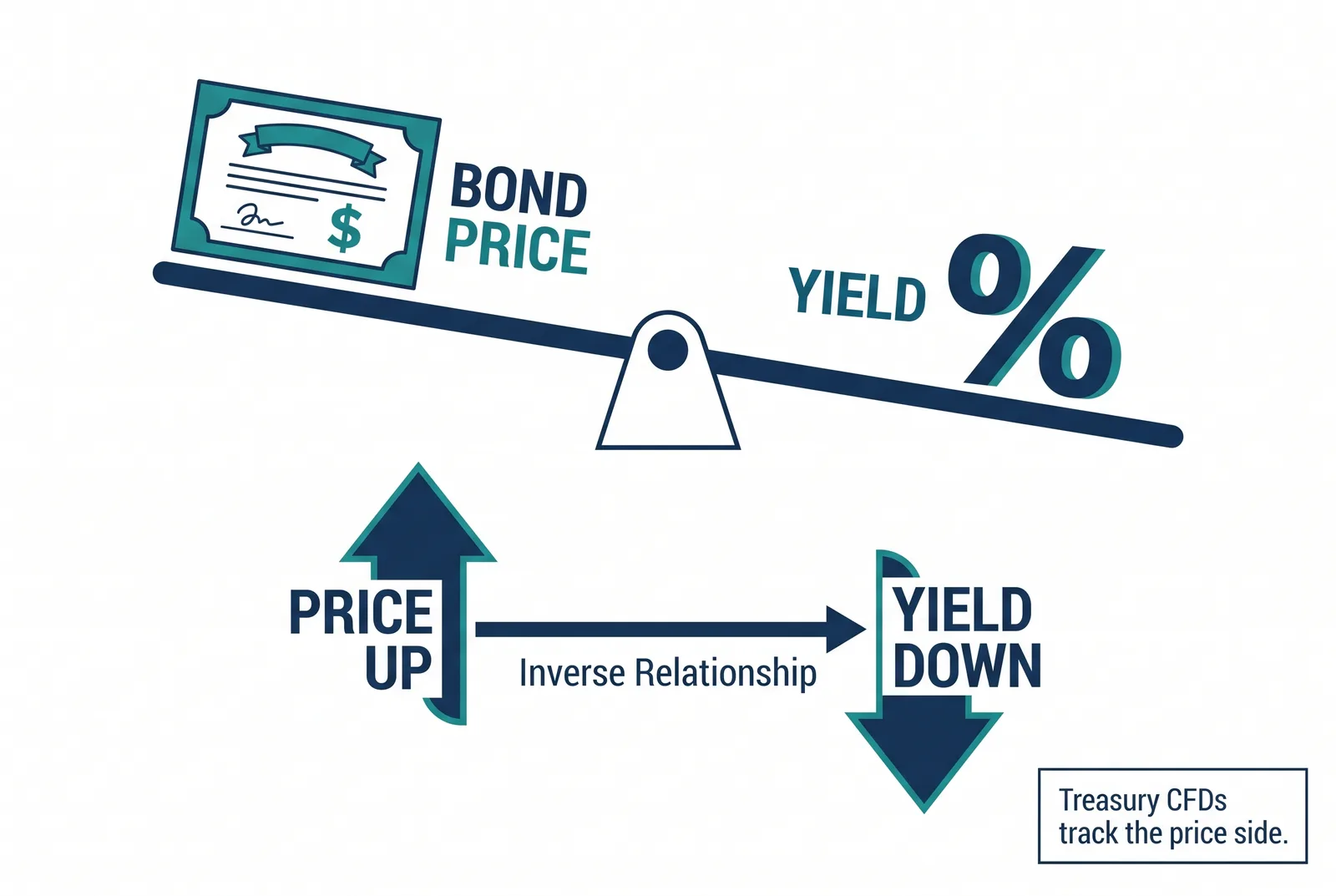
If you trade treasury CFDs, you are tracking the price of a government bond, which moves inversely to its yield. When yields rise, bond prices fall, and your CFD falls with them. You get leveraged exposure to that price without owning the bond or receiving its coupon. In my experience, traders use treasury CFDs to express a view on interest rates. I often suggest that if you expect rate cuts you might go long bond prices, and if you expect rate rises you might go short.
UK gilts, US treasuries and Bunds
In my view, three government-bond markets dominate treasury CFDs for UK traders. I would focus on these three. UK gilts are bonds issued by the UK government, usually traded as the Long Gilt. US treasuries cover the 2, 5 and 10-year notes and the 30-year bond. The German Bund is the European benchmark. When you choose a broker, check that your broker covers at least the Long Gilt, US 10-year and Bund; wider coverage varies, so confirm the instrument set per entity.
FCA leverage and treasury CFDs
For you, the FCA caps your retail leverage on relevant sovereign debt at 30:1. I like that this is the FCA’s one divergence from the ESMA 5:1 reference value. COBS 22.5.11R(1) requires margin of “3.33% of the value of the exposure that the trade provides when the underlying asset is a major foreign exchange pair or relevant sovereign debt”, and 3.33% margin is 30:1. So bond CFDs sit in the same tier as EUR/USD. With £1,000 margin, you control up to £30,000 of bond exposure. Negative balance protection means your retail account cannot fall below zero, and the 50% margin close-out rule applies. We cover the close-out mechanics in how margin works.
CFD Margin Calculator
FCA CFD product intervention rules, COBS 22.5 (PS19/18), permanent since 1 August 2019
£333.33initial margin required
£10,000.00 of exposure needs £333.33 of initial margin at the FCA 30:1 cap.
- Position value£10,000.00
- FCA leverage cap for relevant sovereign debt30:1
- Margin rate3.33%
- Close-out floor (50% of margin)£166.67
The qualifier matters more than the headline. “Relevant sovereign debt” is a defined Handbook term, not a synonym for “government bonds”. The Glossary limits it to debt issued by or on behalf of the UK government, the Scottish Administration, the Executive Committee of the Northern Ireland Assembly, the National Assembly of Wales, an EU member state that has adopted the euro, the United States, Japan, Canada or Switzerland. Gilts, US treasuries and Bunds are therefore 30:1. A government bond outside that list is not: it falls to COBS 22.5.11R(5), which sets 20% margin for “a share or an asset not otherwise listed”, and 20% margin is 5:1. That is a six-fold difference, so check which sovereign you are actually trading before you size a position (COBS 22.5.11R and the Handbook Glossary definition of relevant sovereign debt, both checked 16 July 2026). This distinction is something our team checks on demo and live, GBP-funded accounts.
| Underlying | Margin | Maximum retail leverage |
|---|---|---|
| Major FX pair or relevant sovereign debt | 3.33% | 30:1 |
| Major stock index, minor FX pair or gold | 5% | 20:1 |
| Minor stock index or a commodity other than gold | 10% | 10:1 |
| A share, or any asset not listed above | 20% | 5:1 |
I find the FCA’s reasoning instructive. It judged ESMA’s 5:1 disproportionate because the main government bonds are less volatile than major currency pairs and retail clients use them more for hedging. Applying ESMA’s own methodology to historical prices produced 30:1. The FCA said so in its statement on ESMA’s Opinion (2 July 2019): “Under our rules, UK firms must limit leverage for CFDs and CFD-like options referencing certain government bonds to 30:1 (compared to 5:1 under ESMA’s measures).” If your broker’s global margin table shows 20% on bonds, that is usually the ESMA figure. You should know that PS19/18 records that UK firms must still apply 5:1 when selling to retail clients located in EEA jurisdictions that adopted ESMA’s rules.
Different product, different risks and tax treatment. Interactive Brokers (U.K.) Limited (FRN 208159) routes to the underlying gilt and treasury market rather than offering bond CFDs. Bonds bought this way are owned outright, pay their coupon, and are unleveraged, so they sit outside the FCA’s 30:1 government-bond CFD leverage cap. Dealing is charged as a per-order bond commission rather than inside a CFD spread.
Interactive Brokers scores 87 in our UK review, the highest number on this page, but it is listed here as the direct-access alternative rather than a bond-CFD provider. It suits traders who want to hold the bond itself instead of taking leveraged CFD exposure to its price. Read the full Interactive Brokers review.
Compare brokers by the factor that decides it
Different bond traders weigh cost, platform and market range differently. I suggest you start from the factor that decides it for your trading style. I find that approach works well.

Start with the overall ranking
Our main UK list scores every FCA-regulated broker on cost and execution.

What you trade decides it
Each market carries its own FCA leverage cap, so the by-asset pages rank brokers per instrument.
Cost decides it
The same trade costs different amounts on different account types. These lists rank on the all-in figure. In my view, that is the one to compare.

The platform decides it
Pick your trading software first, then compare the brokers that carry it.
Our reviews are reader-supported. We may receive payment when you click a link to a partner site. Learn how we make money.
FAQs
Is CMC Markets the best treasury CFD broker in the UK?
What leverage applies to treasury CFDs in the UK?
What does a treasury CFD track?
Are bond CFD profits taxed in the UK?
Why do bond prices fall when yields rise?
Can I trade UK gilts directly instead of CFDs?
Related pages
About the author

Justin Grossbard is the co-founder and CEO at CompareForexBrokers. He has traded forex since 1998, leads UK broker research and has personally reviewed every FCA-regulated broker on this site. His work has appeared in Forbes, Kiplinger and Finance Magnates, and he holds a Bachelor of Commerce (Honours) and a Master of Marketing.