
Sessions right now
Session hours anchor to each centre's local market time; daylight saving in each region is applied automatically. The reference table below carries the full year-round schedule.
Risk warning: CFDs are complex instruments and come with a high risk of losing money rapidly due to leverage. The majority of retail investor accounts lose money when trading CFDs. You should consider whether you understand how CFDs work and whether you can afford to take the high risk of losing your money. This page is general information, not financial advice. Advertiser disclosure.
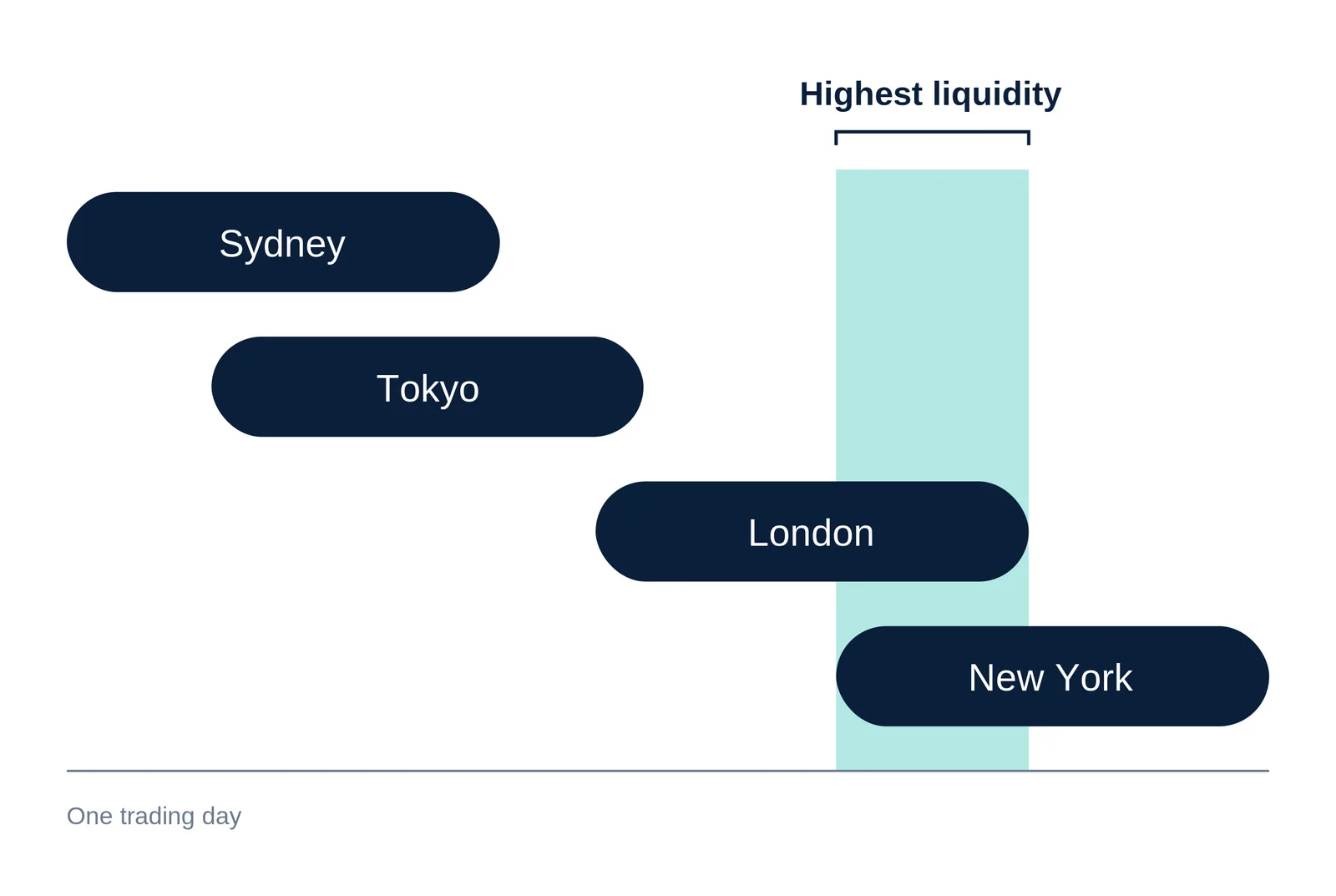
The forex market runs 24 hours a day on weekdays across four sessions: Sydney, Tokyo, London and New York. For a UK trader like you, the London session is the centre of gravity, and I consider the London to New York overlap in the afternoon the highest-liquidity, tightest-spread window of the day.
The four sessions in UK time
Each financial centre opens on its own local clock, so the UK time of a session depends on both the UK daylight saving switch and the overseas one, and the winter column is not simply the summer column minus an hour. Sydney opens late evening UK time, Tokyo just after midnight, London at 8am, and New York at about 1pm. London opens at 08:00 local time all year, so 08:00 BST in summer and 08:00 GMT in winter, and New York’s 8am open lands at about 13:00 on the UK clock in both seasons, because the US and UK move their clocks together apart from a few mismatch weeks. Sydney is the awkward one, because its daylight saving runs opposite to ours, so its open drifts between roughly 20:00 and 22:00 UK time across the year. Our team observes these session timings on live accounts during broker assessments. I rate London’s position as the single largest FX centre highly: it puts the market’s deepest liquidity inside UK working hours, which is a structural advantage for you as a UK-based trader.
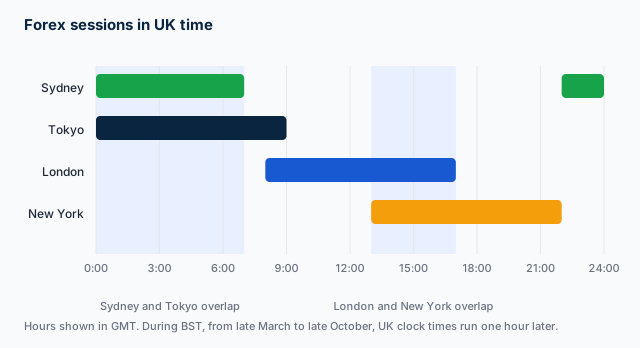
I have included the diagram to show you the four sessions on one 24-hour GMT timeline, with the London and New York overlap running from 1pm to 5pm, and it notes that UK clock times run an hour later during BST.
| Session | Opens (UK summer, BST) | Opens (UK winter, GMT) |
|---|---|---|
| Sydney | 22:00 | 20:00 (Sydney on daylight saving in the UK winter) |
| Tokyo | 01:00 | 00:00 |
| London | 08:00 | 08:00 (opens 8am local time year-round) |
| New York | 13:00 | 13:00 (opens 8am local time year-round) |
Sessions anchor to each centre’s local time, so the UK-clock times you trade shift with both UK and overseas daylight saving. The conversions above use standard session conventions, checked July 2026, and some sources place the Tokyo open at 00:00 UK time in summer. I find that times can differ by an hour for a few weeks around the clock changes, which never land on the same date worldwide.
The London to New York overlap
From roughly 1pm to 5pm on the UK clock, in summer and winter alike, London and New York trade at the same time, and this overlap carries the heaviest volume of the day. Spreads are tightest and price moves cleanest in this window, especially on GBP and EUR pairs. Major UK and US economic releases land around this period, which adds both opportunity and volatility. Because spreads tighten hardest in this window, I consider it the best time to compare lowest spread forex brokers in a live session.
Why it matters for a UK trader
Trading the London open and the afternoon overlap means trading when liquidity is highest and spreads narrowest. Quiet hours, such as late evening after New York closes, carry wider spreads and choppier moves, which raises your cost and slippage. I would suggest matching your trading window to the session that suits your pairs as a simple way to reduce avoidable cost. A broker with strong execution in London hours is worth having, so compare UK forex brokers before committing to one.
Common mistakes
Trading thin overnight hours widens spreads and slippage for no added edge. Ignoring session overlaps misses the cleanest moves of the day. Forgetting the BST to GMT switch throws session timing out by an hour twice a year, and UK clocks change on the last Sundays of March and October. The market also closes across the weekend, and a stop-loss order does not protect against the price gaps that can open when trading resumes on Sunday evening. I would also recommend checking a broker’s execution quality during quiet hours against FCA-regulated broker reviews to avoid nasty slippage surprises.
Session choice is a cost decision as much as a volatility one, because the same pair prices differently at 8am than it does at 8pm. Our pip value calculator shows what a pip is worth on your size, and forex currency pairs UK covers which pairs move in which session. For the wider picture, start at our education hub.
Our reviews are reader-supported. We may receive payment when you click a link to a partner site. Learn how we make money.
FAQs
What are the best hours to trade forex in the UK?
Is the forex market open 24 hours in the UK?
When does the London forex session open?
When does the forex market open on Sunday?
Related pages
About the author

Justin Grossbard is the co-founder and CEO at CompareForexBrokers. He has traded forex since 1998, leads UK broker research and has personally reviewed every FCA-regulated broker on this site. His work has appeared in Forbes, Kiplinger and Finance Magnates, and he holds a Bachelor of Commerce (Honours) and a Master of Marketing.