
I see margin as the deposit a broker requires to open and hold a leveraged CFD position, set as a percentage of the position’s value. The FCA leverage caps fix the minimum margin in the UK, so a 30:1 cap on major forex means you put up about 3.33% of the position’s value. Margin is collateral, not the cost of the trade.
Risk warning: CFDs are complex instruments and come with a high risk of losing money rapidly due to leverage. The majority of retail investor accounts lose money when trading CFDs. You should consider whether you understand how CFDs work and whether you can afford to take the high risk of losing your money. This page is general information, not financial advice. Advertiser disclosure.
Initial and maintenance margin
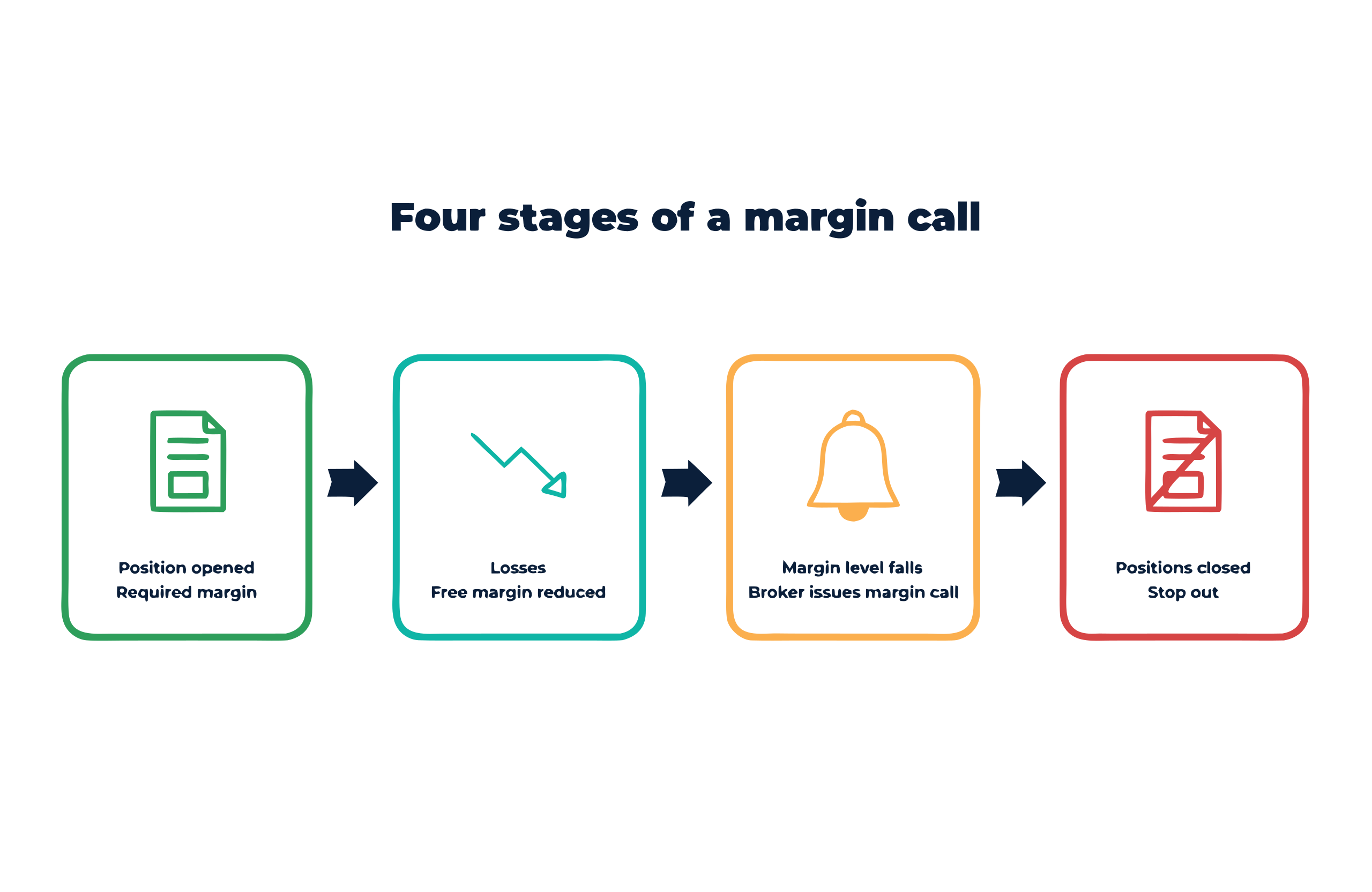
Initial margin is what you post to open a position, derived from the FCA leverage cap for that instrument. Maintenance margin is the equity required to hold the position open. Fall below it and the broker issues a margin call or begins closing positions under the 50% close-out rule, which triggers when account equity drops to half the required margin. The FCA’s PS19/18 leverage cap sets the minimum margin by asset class: major currency pairs at 30:1 need 3.33% margin; non-major pairs and gold at 20:1 need 5%; indices at 20:1 need 5%; individual shares at 5:1 need 20%. Margin level is shown live as a percentage on most trading platforms, including MT4, so you can watch how close an open position sits to a call. I keep an eye on that percentage because it tells you, in real time, how much room you have before the broker steps in.
Initial margin = position size divided by leverage ratio
Free margin and margin level
Platforms show three numbers. Equity is the account balance plus open profit and loss, margin is the amount locked to open positions, and free margin is equity minus that margin. Margin level is equity divided by margin, shown as a percentage, and it is the figure the 50% close-out rule watches. At 100% your equity exactly covers the required margin, and at 50% liquidation begins. Free margin is the practical number day to day, since it is what a new position or an adverse move draws on first. I treat it as the buffer that keeps a trade alive.
A GBP worked example
Take a £20,000 position on GBP/USD at the 30:1 major-pair cap, which is 0.20 of a standard lot. Initial margin is £666.67, which is 3.33% of the position. If losses erode your account equity toward half the margin requirement, the broker starts closing positions to protect the account. Holding several positions at once shares one margin pool, so a loss on one can pull the whole account toward close-out. Our forex calculators return initial margin, pip value and position size in GBP, so the commitment is clear before a position is opened.
| Item | Value |
|---|---|
| Position size | £20,000 on GBP/USD |
| Leverage cap | 30:1 (FCA major-pair cap) |
| Margin required | 3.33% (£666.67) |
| Close-out trigger | 50% of margin (£333.33 equity) |
Following the same £20,000 GBP/USD position, £666.67 initial margin, from a £1,000 account. Each pip is worth £1.47 at that size, at a GBP/USD rate of 1.3592 (28 August 2026), so the moves below convert straight into pounds. That direct translation makes the risk tangible for you.
| GBP/USD move | Open P&L | Equity | Margin level |
|---|---|---|---|
| +100 pips | +£147.15 | £1,147.15 | 172% |
| 0 pips | £0.00 | £1,000.00 | 150% |
| -100 pips | -£147.15 | £852.85 | 128% |
| -200 pips | -£294.29 | £705.71 | 106% |
| -453 pips | -£666.67 | £333.33 | 50%, close-out begins |
The last row is the point the key-data table’s £333.33 equity trigger describes, a move of about 3.3% against a position sized at the cap, from a £1,000 account. A smaller position moves every row further from close-out. I would use our forex margin calculator to run the same figures for any pair and position size at the FCA caps, because it shows you instantly how a change in size shifts the close-out point.
Margin Calculator
Rates as of Fri 28 Aug 2026, 5pm New York close
£666.67margin required
- Notional value£20,000.00
- FCA leverage cap for major currency pairs30:1
- Margin rate3.33%
- Close-out floor (50% of margin)£333.33
The 50% close-out floor at these defaults, 28 August 2026. A 0.20-lot GBP/USD position is £20,000 of exposure, requiring £666.67 of initial margin at the 30:1 cap. The FCA close-out rule bites once account equity falls to 50% of that requirement, which is £333.33. From a £1,000 account that is 453 pips of adverse movement at £1.47 a pip.
Why it matters for a UK trader
Margin is what links leverage to real risk: the smaller the margin, the larger the position relative to your cash, and the faster a move can trigger close-out. Reading margin correctly stops a trader from opening positions an account cannot support. Negative balance protection means a retail account cannot end up owing the broker, even if a gap blows through the close-out level. Margin requirements, negative balance protection and how quickly a broker moves to close-out all vary by firm within the FCA minimums; compare UK forex brokers to see how they differ. Firms also differ in how they warn before acting. Our team checks the warning and close-out sequence across the brokers we review. A broker may flag a platform alert or email as margin level nears 100%, then start closing at 50%, and some close the largest losing position first while others reduce positions proportionally. The exact sequence varies by firm, so I read how each one handles margin calls and close-out in its broker review before I commit to an account.
Common mistakes
The frequent error is mistaking margin for the maximum loss, since losses can exceed the initial margin before close-out completes in fast markets. Running too many positions on one margin pool is another, because correlated losses trigger close-out together. Leverage is the other half of this; see the leverage guide. Read how individual brokers handle margin calls and close-out in our broker reviews, so you can see the differences before you open an account. Margin, the leverage behind it and the stop that should sit in front all sit within the wider trading education hub.
Margin is the mechanism; the stop is what keeps you away from it. The protections sitting behind the close-out, including negative balance protection, are compared across the field on our FCA-regulated broker rankings, and forex stop loss orders for UK traders covers the operational side.
Our reviews are reader-supported. We may receive payment when you click a link to a partner site. Learn how we make money.
FAQs
What is margin in CFD trading?
What is a margin call?
Can I lose more than my margin in the UK?
What leverage can I get trading forex in the UK?
What is free margin?
Related pages
About the author

Justin Grossbard is the co-founder and CEO at CompareForexBrokers. He has traded forex since 1998, leads UK broker research and has personally reviewed every FCA-regulated broker on this site. His work has appeared in Forbes, Kiplinger and Finance Magnates, and he holds a Bachelor of Commerce (Honours) and a Master of Marketing.