
Risk warning: CFDs are complex instruments and come with a high risk of losing money rapidly due to leverage. The majority of retail investor accounts lose money when trading CFDs. You should consider whether you understand how CFDs work and whether you can afford to take the high risk of losing your money. This page is general information, not financial advice. Advertiser disclosure.
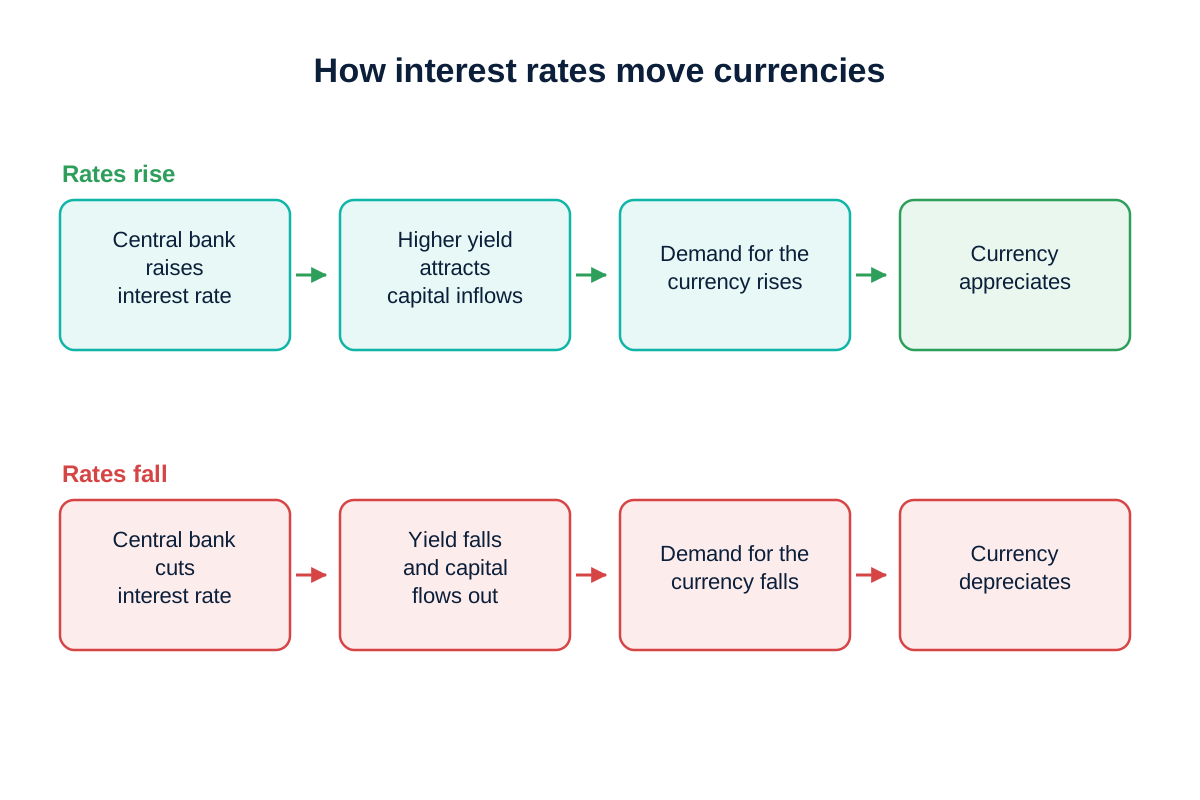
In my view, interest rates set by central banks are among the strongest drivers of currency prices. A currency tends to strengthen when its central bank raises rates or signals a rise, because higher rates attract capital; the Bank of England base rate and its gap with other central banks’ rates shape the GBP pairs you trade.
The central bank policy rates below are a snapshot as at 12 July 2026. Policy rates change at scheduled meetings, so you should treat each figure as dated and confirm the current rate at the relevant central bank before you trade a differential.
| Central bank | Policy rate as at 12 July 2026 | Scheduled rate decisions a year |
|---|---|---|
| Bank of England (Bank Rate) | 3.75% as at 12 July 2026, confirm the current rate at bankofengland.co.uk | 8 (MPC) |
| US Federal Reserve (federal funds target) | Confirm the current target range at federalreserve.gov | 8 (FOMC) |
| European Central Bank (deposit facility) | Confirm the current rate at ecb.europa.eu | 8 |
| Bank of Japan (policy rate) | Around 1% as at 12 July 2026, confirm the current rate at boj.or.jp | 8 |
Rates as published by each central bank, checked 12 July 2026 (sources: bankofengland.co.uk, federalreserve.gov, ecb.europa.eu, boj.or.jp). Because policy rates move at scheduled meetings, recheck the current figure at the relevant bank before trading a differential; this page carries the last checked date so a stale rate is easy to spot.
How do central banks and rate differentials move forex?
The Bank of England sets the UK base rate across eight Monetary Policy Committee meetings a year, and its decisions move GBP pairs sharply. Other major banks matter too: the US Federal Reserve, the European Central Bank and the Bank of Japan. What drives a pair is the differential, the gap between the two currencies’ rates, so your GBP/USD trades react to both the BoE and the Fed. For your trading, the way those majors and crosses are quoted is set out in the forex currency pairs guide. The current policy rates and meeting cadence for these banks are summarised in the dated table at the top of this page.
A GBP carry-trade example
I find that a carry trade borrows a low-rate currency to hold a higher-rate one, earning the rate differential while the position is open. Buying GBP/JPY when UK rates sit well above Japanese rates earns positive carry on the position, paid as a small daily credit. With the Bank Rate at 3.75% and the Bank of Japan’s policy rate near 1% as at 12 July 2026, both stamped in the table above and worth rechecking at source, the roughly 2.75% annual differential on a £30,000 GBP/JPY position works out to about £2.25 a day in positive carry before any price movement in the pair. In practice the credit you receive is the broker’s swap rate, which builds a markup into the raw central-bank differential, so the figure actually paid is lower than the headline rates imply. I would stress that any leverage stays within the FCA’s retail caps, and a sharp move in the pair can wipe out months of carry in a day, so the strategy is far from risk-free. If you are considering a carry position, compare top FCA-regulated forex brokers for competitive overnight financing, because swap rates vary and our team assesses them under live accounts.
Why it matters for a UK trader
Rate decisions and the language around them create the largest scheduled moves in GBP pairs. Anticipating a shift in the differential, rather than reacting after the announcement, is where the edge sits, and it is hard to do reliably. I keep the BoE meeting calendar close because it helps me manage my exposure around the highest-volatility events. If you trade GBP pairs, you should do the same. Rate expectations also move equity indices, so the same central-bank decisions feed through to index CFD pricing. Checking a broker’s rate-decision execution record against FCA-regulated broker reviews matters most around those events.
Common mistakes
I would caution that if you trade a rate decision without sizing for the volatility around it, you invite a fast loss. Reading the headline rate while ignoring the forward guidance misses what often moves the market more. Chasing carry without respecting the currency risk treats a leveraged position as a savings account. Trading a rate decision on a variable-spread account risks the widest costs exactly when volatility peaks, which is why some UK traders prefer fixed spread brokers around scheduled announcements.
Rates set the medium-term direction; the rest of the trade is cost and sizing. Our broker cost calculator totals what a position costs to hold, and forex currency pairs UK covers which pairs carry the differential most directly. For the wider picture, start at our education hub.
Our reviews are reader-supported. We may receive payment when you click a link to a partner site. Learn how we make money.
FAQs
How do interest rates affect forex?
What is a carry trade?
How often does the Bank of England set rates?
Is carry trade risk-free?
Why is my swap credit smaller than the rate differential?
Related pages
About the author

Justin Grossbard is the co-founder and CEO at CompareForexBrokers. He has traded forex since 1998, leads UK broker research and has personally reviewed every FCA-regulated broker on this site. His work has appeared in Forbes, Kiplinger and Finance Magnates, and he holds a Bachelor of Commerce (Honours) and a Master of Marketing.