
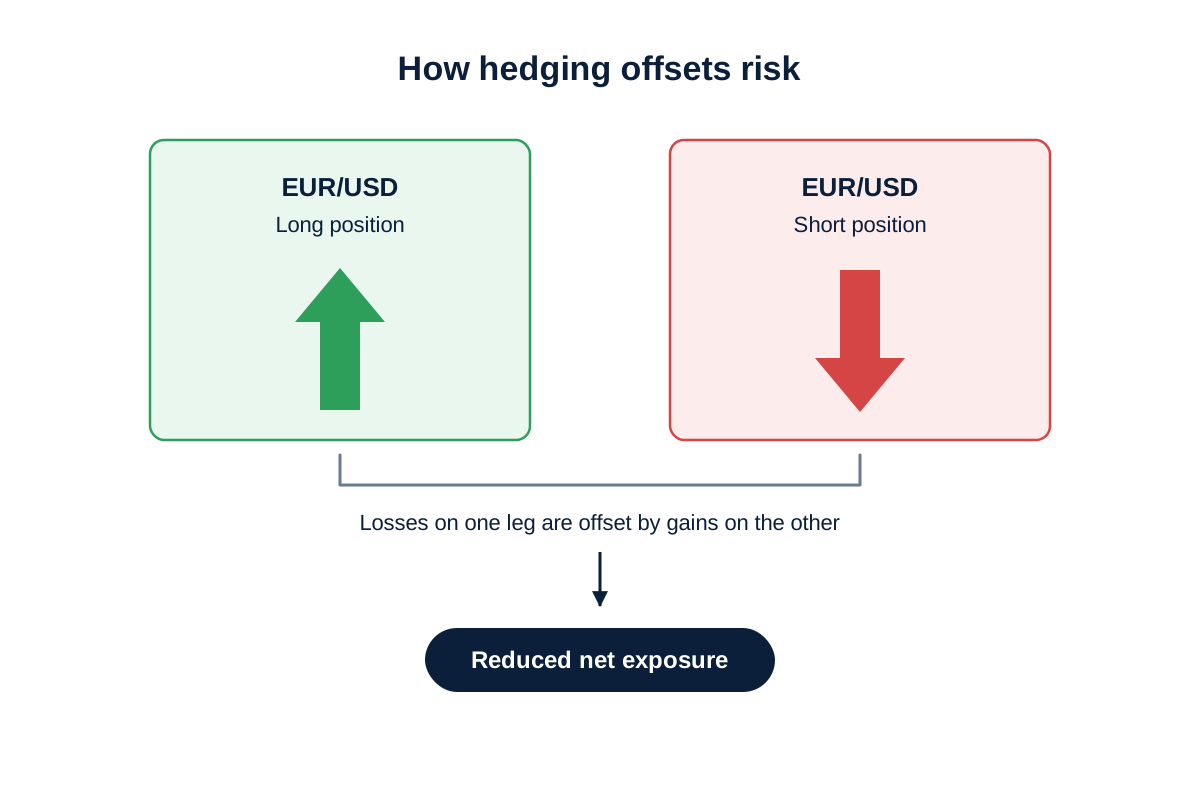
In my view, hedging in forex means opening a position to offset the risk of another, reducing your exposure to an adverse move. A UK trader hedging a long GBP/USD position against a short-term reversal, or hedging currency exposure from holding overseas assets, limits downside but also caps upside and adds cost.
Risk warning: CFDs are complex instruments and come with a high risk of losing money rapidly due to leverage. The majority of retail investor accounts lose money when trading CFDs. You should consider whether you understand how CFDs work and whether you can afford to take the high risk of losing your money. This page is general information, not financial advice. Advertiser disclosure.
| Hedge type | How it works | Main cost | Residual risk |
|---|---|---|---|
| Direct, same pair | Hold a long and a short GBP/USD at once | Spread on both legs, margin treatment varies by broker | Near zero while both legs stay open |
| Correlated pair | Offset GBP/USD with a EUR/USD position | Spread on both legs | Correlation gap, the pairs do not move identically |
| Options | Pay a premium for the right to a price | Premium paid up front | Limited to the premium, retail availability limited under FCA rules |
What is the difference between a direct and an indirect hedge?
Hedging works in three ways. A direct hedge opens an opposite position in the same pair, holding a long and a short GBP/USD at once to freeze your exposure. An indirect hedge uses a correlated pair, such as offsetting GBP/USD with a position in EUR/USD, which move together but not identically. Options offer a third route, paying a premium for the right to a price, though retail options availability is limited under FCA rules. The table at the top of this page summarises the cost and residual risk of each route.
A GBP hedging example
Consider holding a long £50,000 GBP/USD position into a Bank of England decision you expect to be volatile. Opening a short of similar size freezes the net exposure through the announcement, so a sharp move either way nets close to flat. Lifting the hedge once volatility passes keeps your original view. At a GBP/USD spread of around half a pip, typical of the raw-account averages in our broker testing and checked in July 2026, opening and later closing both legs of a £50,000 hedge costs in the region of £4 in spread alone, before any commission. I consider that a modest cost for removing event risk. Any leverage on both legs stays within the FCA 30:1 major-pair cap.
Why it matters for a UK trader
I see hedging as a risk tool, not a profit tool. It protects a position or a portfolio through an uncertain window. One persistent myth is worth killing off. Hedging is not banned in the UK. The no-hedging rule that traders half-remember is a US measure, the first-in, first-out requirement in NFA Rule 2-43b, imposed by the National Futures Association under CFTC oversight on American retail forex accounts. Neither the FCA nor ESMA has ever imposed an equivalent, and the FCA’s PS19/18 retail rules cap leverage and margin on each leg, not whether you may hold both. It suits you when managing event risk, and it suits investors with currency exposure from overseas holdings. The cost is real, through spreads on both legs and the upside given up, so a hedge is worth it only when the risk it removes is worth the cost. Because the cost is paid in spread on both legs, in my view comparing lowest spread forex brokers before hedging regularly makes sense. Hedging is something our team checks on demo and live, GBP-funded accounts.
Common mistakes
Hedging to avoid taking a loss, rather than to manage a defined risk, usually just locks in the spread twice. Assuming correlated pairs move identically leaves a gap the hedge does not cover. Forgetting that a hedge caps upside surprises traders when the market runs in their original direction. MT4 brokers UK differ in whether they net opposing positions into one, so I recommend checking your broker’s hedging support before relying on it. Margin treatment differs too. Some brokers margin only the larger leg of a direct hedge while others margin both in full, which can double the capital a hedge ties up, so check your broker’s margin policy before the event, not during it. Checking that support against FCA-regulated broker reviews helps you avoid the netting surprise described above. The drawdown guide covers the risk side, and other risk-management guides live in the education hub.
A hedge is one answer to an exposure you already hold; a stop is the other, and usually the cheaper one. Our forex stop loss orders for UK traders page sets out that alternative, and our position size calculator sizes each leg against a fixed risk budget rather than a lot count.
Our reviews are reader-supported. We may receive payment when you click a link to a partner site. Learn how we make money.
FAQs
What is hedging in forex?
Is forex hedging allowed in the UK?
Does hedging guarantee no loss?
Does a hedge reduce my margin requirement?
Do all FCA-regulated brokers allow hedging?
Related pages
About the author

Justin Grossbard is the co-founder and CEO at CompareForexBrokers. He has traded forex since 1998, leads UK broker research and has personally reviewed every FCA-regulated broker on this site. His work has appeared in Forbes, Kiplinger and Finance Magnates, and he holds a Bachelor of Commerce (Honours) and a Master of Marketing.