
Risk warning: CFDs are complex instruments and come with a high risk of losing money rapidly due to leverage. The majority of retail investor accounts lose money when trading CFDs. You should consider whether you understand how CFDs work and whether you can afford to take the high risk of losing your money. This page is general information, not financial advice. Advertiser disclosure.
I break broker revenue into three main sources: the spread, commissions on raw-spread accounts, and overnight financing on held positions. Market-maker brokers also profit by taking the other side of client trades. Knowing where a broker earns tells you where your own trading costs come from, and that is the starting point for any cost comparison.
Spreads and commissions
The spread, the gap between buy and sell price, is the most common revenue source, built into every trade. I see raw-spread accounts as a better fit for active traders because they narrow the spread and charge a separate commission per lot. Either way, you pay on entry and exit, so the all-in cost (spread plus commission) is the figure that matters, not the headline spread alone. For a standard one-lot EUR/USD trade, a 1-pip spread costs roughly £8 at an illustrative GBP/USD rate near 1.27; a raw-spread account might charge about £4.50 per lot in commission on a spread closer to 0.2 pips. At normal trade sizes, the all-in cost is comparable.
The market-maker model and who profits when you lose
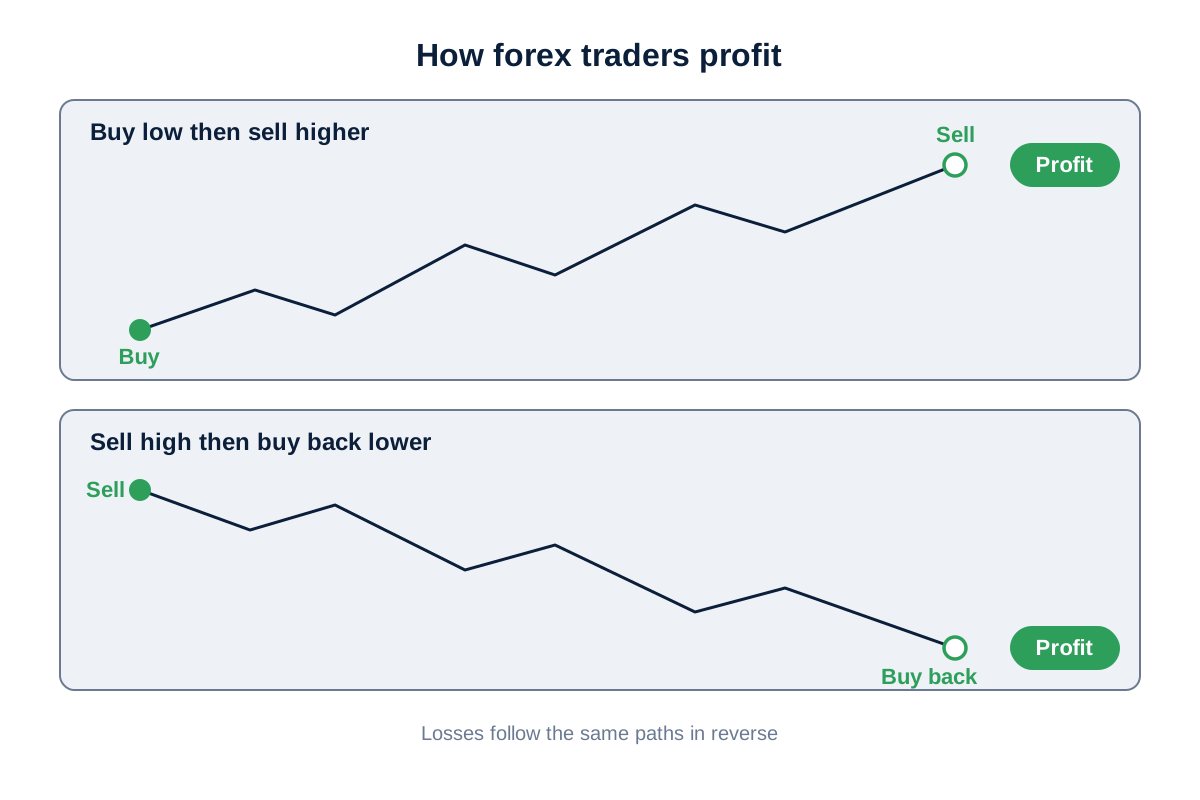
Market-maker brokers earn on top of the spread by taking the other side of client trades, which means they can profit when clients lose. That is why I view their execution model as carrying a potential conflict of interest. ECN and STP brokers avoid that conflict by routing orders to liquidity providers and earning the commission instead, as explained in the market maker guide. This does not make every client loss the broker’s gain. Across FCA-authorised firms, the share of retail accounts that lose money runs roughly 51% to 82% depending on the broker, and each firm must publish its own figure (each broker’s own disclosure, checked July 2026). You can compare how individual firms disclose spreads, commissions and execution model side by side in our broker reviews.
What this costs you in practice
I have summarised the two pricing models below as a quick reference, and the worked comparison puts them side by side for a realistic account.
| Cost line | Typical advertised rate | Cost on one standard lot of EUR/USD, round turn |
|---|---|---|
| Standard spread | ~1.0 pip | ~£8 |
| Raw spread plus commission | ~0.2 pip plus ~£4.50 per lot | ~£6 |
| Overnight financing (held position) | Varies with the rate differential | Charged or credited nightly |
Indicative advertised rates, checked July 2026. Pip values are converted at an illustrative GBP/USD rate near 1.27, so a one-pip move on a standard lot (worth about $10) is roughly £8. The raw commission of about £4.50 per standard lot round turn reflects a rate of roughly £2.25 per side (Pepperstone’s Razor account, verified July 2026); other raw accounts are broadly similar but vary, so check each broker’s schedule.
The worked comparison below puts the two account models side by side for you, 50 trades of one mini lot (10,000 units) of EUR/USD on a £5,000 account.
| Cost line | Standard account | Raw account |
|---|---|---|
| Spread | ||
| Commission | £0 | ~£0.45 per round turn |
| All-in cost per trade | ~£0.80 | ~£0.60 |
| Cost over 50 trades | ~£40 | ~£30 |
| Share of the £5,000 account | 0.8% | 0.6% |
Indicative advertised rates, checked July 2026. A mini lot of EUR/USD is worth about $1 per pip, which is roughly £0.80 at the illustrative rate above. The raw commission scales down to about £0.45 per mini lot from the £4.50 per standard lot figure. I find that scale is what turns pips into pounds. The same 50 trades in full standard lots cost roughly £400 against £300, and the broker’s revenue and your cost are the same number.
What the big UK brokers actually charge
The models above are not abstractions, because every FCA-regulated broker publishes which one it runs. I have included a sample below that shows the pricing model and an indicative EUR/USD spread for six FCA-authorised firms, each named with its UK entity and firm reference number so you can confirm it on the FCA register.
| Broker | FCA entity (FRN) | Pricing model | Indicative EUR/USD spread |
|---|---|---|---|
| Pepperstone | Pepperstone Limited (684312) | Raw plus commission or standard spread | From 0.0 pips on Razor (advertised) |
| Eightcap | Eightcap Group Ltd (921296) | Raw plus commission or standard spread | From 0.0 pips (advertised) |
| Tickmill | Tickmill UK Ltd (717270) | Raw plus commission or standard spread | From 0.0 pips (advertised) |
| IG Markets | IG Markets Limited (195355) | Spread only | About 0.6 pips (advertised) |
| CMC Markets | CMC Markets UK plc (173730) | Spread only | About 0.5 pips (advertised) |
| Plus500 | Plus500UK Ltd (509909) | Spread only, market maker | Dynamic (advertised) |






Indicative advertised rates from each broker’s UK site, checked July 2026, shown to illustrate the pricing model rather than to rank the firms. Spread-only pricing is not automatically dearer, because your all-in cost depends on your trade size and frequency. That is why our lowest spread and lowest commission comparisons rank the total figure rather than the model. I do not give scores or recommendations in this table.
How overnight financing works in pounds
Holding one mini lot of GBP/USD long past the daily cut-off means the broker charges financing built from the gap between the Bank of England’s Bank Rate and the US federal funds rate, plus the broker’s own markup. On roughly £10,000 of exposure, a typical charge runs in the order of £0.50 to £1.00 a night (indicative, check each broker’s schedule). That is small daily and decisive monthly. 20 nights costs about £10 to £20, as much as the spread on 10 to 20 of the trades above. Swap can also run the other way, since holding the higher-yielding currency means some brokers credit the account, minus the markup. Both central-bank rates move, so you should check the current Bank of England Bank Rate and the Federal Reserve target range at the time rather than assuming a figure (Bank of England and Federal Reserve, rates subject to change, July 2026).
The smaller revenue lines
Three quieter charges round out the model. Inactivity fees, commonly around £10 to £12 a month after 12 to 24 months without a trade (indicative, varies by broker), monetise dormant accounts. Currency-conversion fees apply when the account is held in GBP but the instrument settles in USD or EUR, typically 0.5% to 1.0% of the converted amount (indicative). Guaranteed-stop premiums charge for certainty, since the broker takes on your gap risk in return for a wider spread or a fee when the stop triggers. None of these shows up in a headline spread comparison, which is why each broker’s review lists them separately.
How to use this when choosing a broker
Every revenue source is a cost to you, so reading the model shows where you pay. A scalper cares most about spread and commission, while a position trader cares more about overnight financing. Match the account type to how you actually trade, compare the all-in cost rather than the advertised spread using the lowest spread and lowest commission guides, and check the execution model, since it affects both cost and conflict of interest. UK brokers all operate under the FCA’s product-intervention and conduct rules, which is why pricing and risk warnings look broadly similar across the field. Any personal gains from CFD and forex trading fall under UK Capital Gains Tax rather than Income Tax for most retail traders; see the CFD trading guide for how this is treated. Read how a firm is rated before trusting its cost claims, set out on the methodology page, and browse the rest of the trading education hub for the mechanics behind each cost, all of which our team verifies on live GBP-funded accounts.
Knowing where the revenue comes from is only useful if you can price it. Our broker cost calculator totals spread and commission at your own volume, and what is a market maker in forex? covers which execution model sits behind the pricing.
Our reviews are reader-supported. We may receive payment when you click a link to a partner site. Learn how we make money.
FAQs
How do forex brokers make money?
Do brokers profit when traders lose?
What is the swap or overnight financing fee?
How do I compare broker costs before opening an account?
Do FCA brokers charge inactivity fees?
Is a raw-spread account always cheaper?
Related pages
About the author

Justin Grossbard is the co-founder and CEO at CompareForexBrokers. He has traded forex since 1998, leads UK broker research and has personally reviewed every FCA-regulated broker on this site. His work has appeared in Forbes, Kiplinger and Finance Magnates, and he holds a Bachelor of Commerce (Honours) and a Master of Marketing.