
Risk warning: CFDs are complex instruments and come with a high risk of losing money rapidly due to leverage. The majority of retail investor accounts lose money when trading CFDs. You should consider whether you understand how CFDs work and whether you can afford to take the high risk of losing your money. This page is general information, not financial advice. Advertiser disclosure.
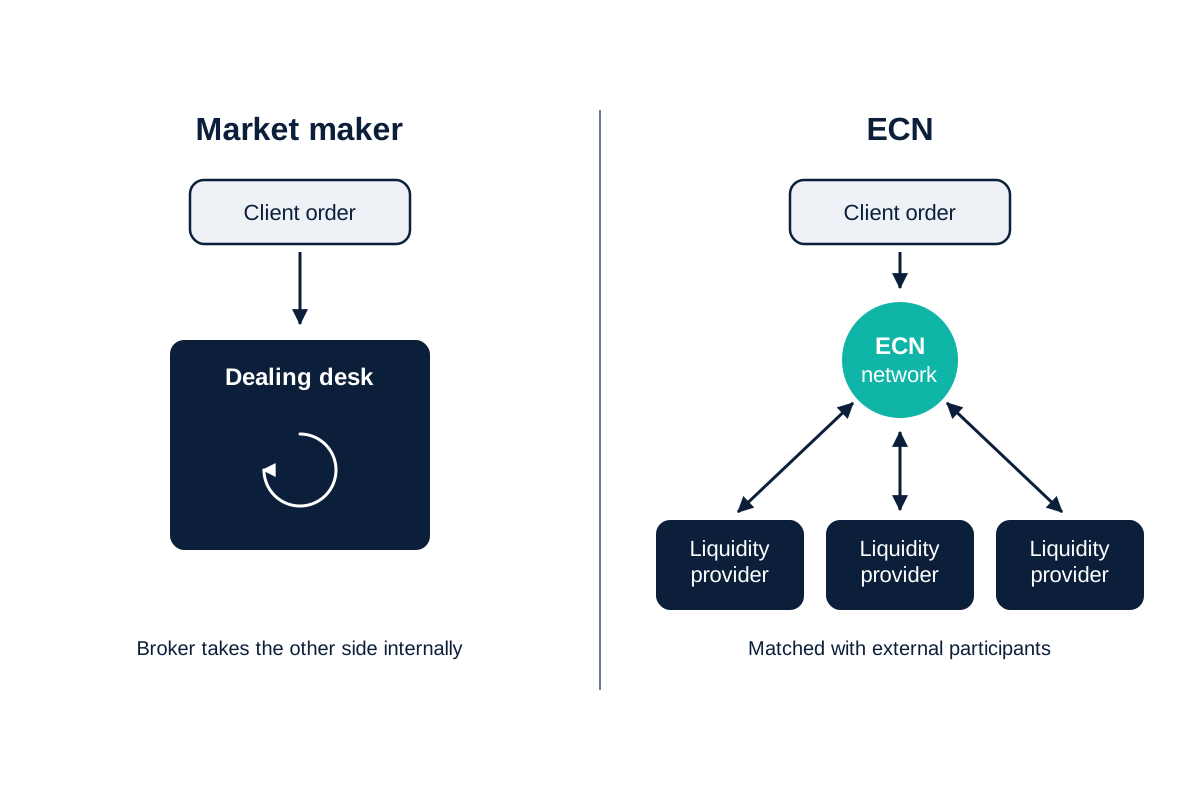
A market maker is a forex broker that quotes its own buy and sell prices and takes the other side of client trades, rather than routing them to the wider market. ECN or STP execution passes orders to liquidity providers. The model you use affects your spread and cost, and the potential for a conflict of interest.
How a market maker works
A market-maker broker sets its own bid and ask, profiting from the spread and from positions it holds against clients. It can offer fixed spreads and fill small accounts that an ECN venue would price poorly. A typical market-maker EUR/USD spread runs 1.0 to 1.5 pips with no separate commission, versus a raw ECN spread of around 0.2 pips plus roughly £6 per lot round-turn commission, which in my experience works out to a similar all-in cost at your normal trade size. I would not assume one is always cheaper without checking the numbers on your own trade size. Because the broker is the counterparty, a conflict of interest can arise, which FCA regulation, segregation and conduct rules are designed to contain. The spread and financing that fund this model are covered in full in how forex brokers make money.
A-book, B-book and hybrid desks
The industry’s own terms for the two models are A-book and B-book. A-book means the broker hedges or passes your order to a liquidity provider and keeps the commission or markup, the ECN and STP pattern. B-book means the broker holds the trade on its own book, so a client loss is the broker’s gain, the market-making pattern. Most large firms run hybrids, so your small retail flow may be kept on the book while large or consistently winning accounts are passed through to the market. I view this as a pricing question rather than a question of legality, because FCA conduct rules and best-execution obligations apply to both books.
Market maker versus ECN and STP
An ECN broker routes orders into a network of liquidity providers and charges a commission on a raw spread, so its interest aligns with filling your order well. STP brokers pass orders straight through to liquidity providers without a dealing desk. In my opinion, market makers suit beginners and fixed-spread traders; if you are starting out or want fixed spreads, they may work for you. ECN and STP suit active traders chasing the tightest raw cost, covered in the ECN guide.
| Feature | Market maker | ECN/STP |
|---|---|---|
| Price source | Broker’s own quote | Aggregated liquidity providers |
| Typical EUR/USD spread | 1.0-1.5 pips, often fixed | ~0.2 pips + £6/lot commission |
| Broker’s counterparty role | Takes the other side of trades | Passes orders through |
| Best suited for | Beginners, fixed-spread traders | Active traders chasing raw cost |
Representative advertised EUR/USD rates across FCA-regulated UK brokers were checked in July 2026. Individual account pricing varies, so confirm the current figure on each broker’s own UK site.
The split is visible in the UK roster, though the labels here describe each firm’s account structure rather than fix a firm as purely one model. Plus500 prices on a spread only with no separate commission, and Trade Nation runs genuinely fixed spreads, both consistent with a market-making model. Our team verifies these models through live account testing. Pepperstone states that its Razor account runs no dealing desk, and Eightcap routes raw-account orders straight through to liquidity providers, the agency-style STP pattern. Tickmill prices its Raw account on the same raw-spread-plus-commission basis. The same firm can run more than one model, and FxPro offers an all-in floating Standard account alongside raw-spread-plus-commission accounts. Our check of each broker’s own UK pricing and execution disclosures, from July 2026, confirms these classifications.
How to tell which model your broker uses
I recommend checking the account type rather than the marketing. A raw-spread account charging a per-lot commission is usually ECN or STP. Zero-commission accounts with a wider all-in spread, especially fixed ones, are usually market-making. An FCA-regulated broker states its execution model in its terms; read those before opening an account, since some firms run both models on different accounts. See how individual firms disclose their execution model in our broker reviews.
Common mistakes
Assuming a market maker is automatically worse ignores that the model suits some traders and accounts. Reading the headline spread without the commission misjudges the all-in cost on a raw account. Choosing on model alone, rather than total cost and FCA regulation, misses what actually affects your results. Total cost matters more than the label; compare all-in pricing across providers in the lowest spread brokers guide. Execution model, cost and risk topics sit together in the wider trading education hub.
Which model suits you is a cost question, so it is worth settling with numbers rather than principle. Our guide to fixed spread brokers covers the market-made alternative to the ECN route, our broker cost calculator totals spread against commission at your own volume, and how forex brokers make money in the UK covers the revenue side in full.
Our reviews are reader-supported. We may receive payment when you click a link to a partner site. Learn how we make money.
FAQs
What is a market maker in forex?
Which is better, a market maker or an ECN broker?
How do I know if my broker is a market maker?
Are UK market makers regulated?
What is B-booking?
Related pages
About the author

Justin Grossbard is the co-founder and CEO at CompareForexBrokers. He has traded forex since 1998, leads UK broker research and has personally reviewed every FCA-regulated broker on this site. His work has appeared in Forbes, Kiplinger and Finance Magnates, and he holds a Bachelor of Commerce (Honours) and a Master of Marketing.