
Risk warning: CFDs are complex instruments and come with a high risk of losing money rapidly due to leverage. The majority of retail investor accounts lose money when trading CFDs. You should consider whether you understand how CFDs work and whether you can afford to take the high risk of losing your money. This page is general information, not financial advice. Advertiser disclosure.
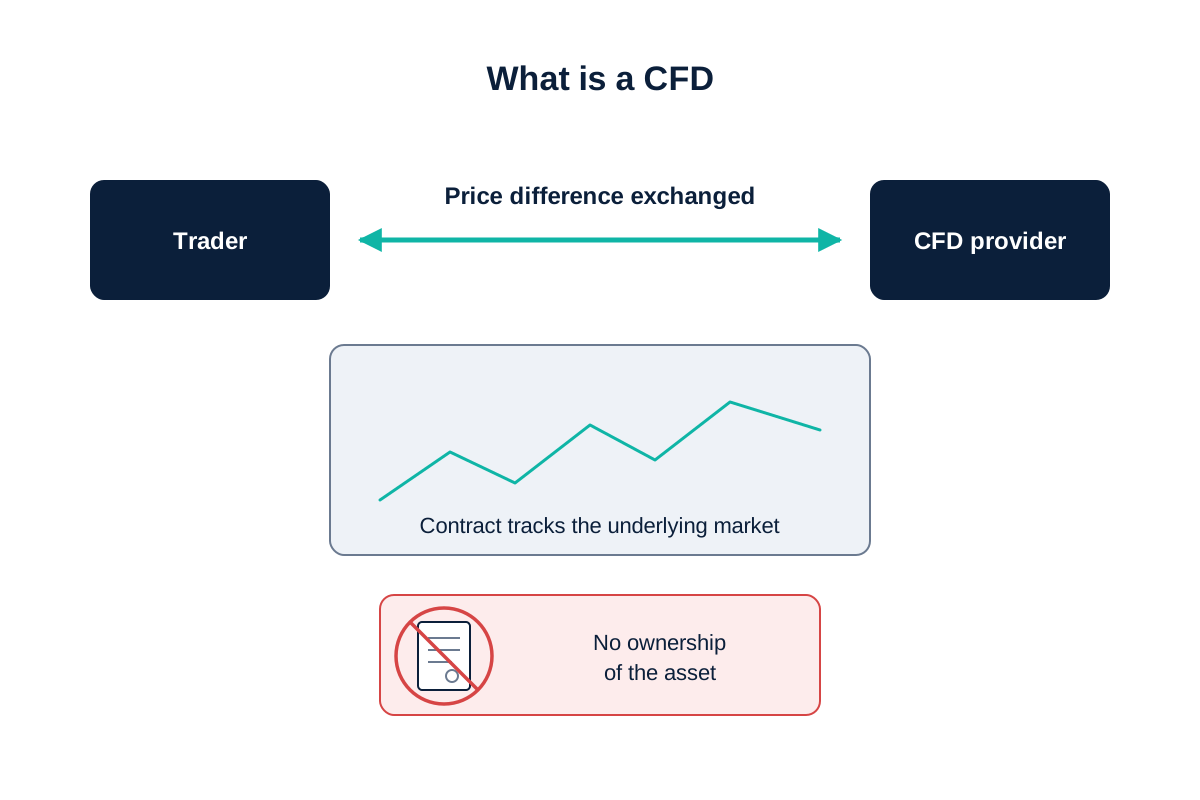
A contract for difference is a leveraged agreement to exchange the change in an asset’s price between opening and closing a position, without owning the asset. The FCA caps that leverage at 30:1 on major currency pairs, so £1,000 of margin controls up to £30,000 of exposure. I rate that cap as a sensible guardrail for retail accounts, because it limits how fast a move can erode your deposit. A UK trader can go long or short on forex, indices, shares and commodities on that basis, with FSCS cover behind the firm.
How a CFD works in practice
Open a CFD position and you agree to settle the difference between the entry and exit price, multiplied by your position size. Going long profits if the price rises; going short profits if it falls. Because the position is leveraged, you post a margin deposit rather than the full value, so both gains and losses are magnified against that deposit. A retail account cannot fall below zero, because negative balance protection applies under FCA rules. Not every CFD broker offers the same instrument range, margin terms or execution model; compare providers in the best CFD brokers UK hub. Two worked CFD examples put a long and a short trade into numbers.
FCA leverage caps on CFDs
The FCA caps retail CFD leverage per instrument under the FCA’s PS19/18 product-intervention rules. Major currency pairs are capped at 30:1. CFDs referencing certain government bonds are also capped at 30:1, the one tier where the FCA deliberately diverged from ESMA’s reference measures, which put bonds at 5:1. Non-major pairs, gold and major stock indices sit at 20:1, other commodities and non-major indices at 10:1, and individual shares at 5:1. A 50% margin close-out rule applies per account, and every firm must display a standardised risk warning showing its own percentage of losing retail accounts.
| Asset class | Retail leverage cap |
|---|---|
| Major currency pairs | 30:1 |
| Certain government bonds | 30:1 |
| Non-major currency pairs, gold and major stock indices | 20:1 |
| Commodities other than gold, and non-major stock indices | 10:1 |
| Individual shares and other reference values | 5:1 |
Crypto-asset CFDs are banned for UK retail clients under FCA PS20/10, in force since 6 January 2021.
Source: FCA PS19/18 (in force 1 August 2019) and the FCA’s statement on ESMA’s Opinion, fca.org.uk; checked July 2026.
Your live margin usage against these caps is shown on trading platforms such as MT4 and MT5. I find that watching the margin level in real time helps new traders avoid over-leveraging.
How CFDs are taxed in the UK
CFD profits fall within Capital Gains Tax for UK residents, and CFD losses can offset capital gains. The Capital Gains Tax annual exempt amount is £3,000 for the 2025/26 tax year, with gains above it taxed at 18% for basic-rate taxpayers and 24% for higher and additional-rate taxpayers. No stamp duty applies to CFDs, because no share changes hands, unlike a direct UK share purchase, which incurs 0.5% Stamp Duty Reserve Tax. HMRC does not normally treat placing a spread bet as trading, so those profits are not taxed and losses attract no relief (BIM22015), which is the main tax distinction between the two; compare FCA-regulated providers for both CFD and spread-betting accounts in our broker reviews. Our team tests broker platforms. Tax treatment depends on individual circumstances and may change. I would start with the CFD route because the loss relief gives flexibility.
These figures reflect HMRC Capital Gains Tax guidance for the 2025/26 tax year; allowances and rates can change each tax year, so confirm the current-year position with HMRC. Checked July 2026.
CFD, spread bet or owning the asset?
A CFD, a spread bet and a direct purchase can all express the same market view, but they differ in ownership, tax and cost. In my view, the choice turns on whether you need loss relief and want to avoid stamp duty. The table restates the practical differences, while the prose above covers the tax detail in full.
| Feature | CFD | Spread bet | Owning the asset |
|---|---|---|---|
| You own the underlying | No | No | Yes |
| Capital Gains Tax on profits | Yes | No, treated as gambling | Yes |
| Losses offset capital gains | Yes | No | Yes |
| 0.5% Stamp Duty Reserve Tax on UK shares | No | No | Yes |
| FCA retail leverage available | Up to 30:1 by asset class | Up to 30:1 by asset class | None |
| Dividends | Cash adjustment only | Adjustment only | Paid, with voting rights |
Spread betting is available only from UK and Irish firms and its tax treatment can change, whereas CFDs are the internationally standard product. Neither instrument confers shareholder rights. Which one suits you depends on trade size, holding period and tax position, not on which looks cheaper at first glance. I would lean towards a CFD account for frequent traders wanting to offset losses.
Common mistakes
New traders often misjudge leverage, treating the margin deposit as the risk rather than the full position size. Ignoring the all-in cost is another error, since the spread and any commission apply on every trade. Confusing CFDs with owning the underlying asset leads to surprise on dividends and voting rights, neither of which a CFD confers. Comparing execution quality and the all-in cost of a trade across FCA-regulated brokers before opening an account avoids most of these mistakes. For the rest of the core concepts, the forex and CFD education hub collects each explainer in one place. I would add that starting with a demo account lets you see leverage and costs in action without risking capital.
The contract is the starting point; the costs and the comparison come next. Our margin calculator shows what a position ties up under the FCA caps, and CFD trading examples UK works a long and a short trade through in GBP. When you are ready to pick a provider rather than understand the product, our best CFD brokers UK hub ranks the FCA-regulated field on cost, platform and execution.
Our reviews are reader-supported. We may receive payment when you click a link to a partner site. Learn how we make money.
FAQs
What is CFD trading in simple terms?
Is CFD trading taxed in the UK?
Is CFD trading legal in the UK?
Can I lose more than I deposit trading CFDs?
What is the difference between a CFD and spread betting?
Do I receive dividends on a share CFD?
Related pages
About the author

Justin Grossbard is the co-founder and CEO at CompareForexBrokers. He has traded forex since 1998, leads UK broker research and has personally reviewed every FCA-regulated broker on this site. His work has appeared in Forbes, Kiplinger and Finance Magnates, and he holds a Bachelor of Commerce (Honours) and a Master of Marketing.