
Risk warning: CFDs are complex instruments and come with a high risk of losing money rapidly due to leverage. The majority of retail investor accounts lose money when trading CFDs. You should consider whether you understand how CFDs work and whether you can afford to take the high risk of losing your money. This page is general information, not financial advice. Advertiser disclosure.
The UK is the largest forex trading centre in the world, handling 37.8% of global FX turnover in the April 2025 BIS Triennial Survey. Alongside that scale, you face a sobering retail figure: most UK retail accounts lose money trading CFDs, a statistic FCA-regulated firms must disclose. I would treat that number as the first thing to check on any broker’s page.
London leads global FX
The Bank for International Settlements runs a triennial survey of global FX turnover, and the UK consistently ranks first. London handled 37.8% of global daily FX turnover in the April 2025 survey, more than any other centre and down from about 43% in 2019; global turnover reached $9.6 trillion a day (roughly £7.2 trillion). For you as a UK trader, that concentration means the London session carries the deepest liquidity and tightest spreads.
| Financial centre | Share of global FX turnover (April 2025) |
|---|---|
| United Kingdom | 37.8% |
| United States | 19% |
| Singapore | 11.8% |
| Hong Kong SAR | 7.0% |
Source: BIS Triennial Central Bank Survey, April 2025 (bis.org, checked July 2026). These four centres together handled around 75% of global FX turnover, and the US share is shown as a rounded figure.
The retail loss rate
FCA rules require brokers to display the percentage of retail accounts that lose money, a median of 71% across the 24 FCA-regulated firms our team tracks and a published range of 51% to 82% (each firm’s own standardised risk-warning disclosure, checked July 2026). I regard that figure as the headline reality of retail CFD trading, not a footnote. It reflects the combined effect of leverage, cost and the difficulty of consistent timing, which is why the FCA’s product-intervention rules cap leverage and mandate the disclosure. Because most retail accounts lose money, broker choice, costs and execution quality genuinely matter; compare the top FCA-regulated forex brokers on cost. Before you fund an account, make that loss rate your starting point.
The disclosed loss rates by broker
The mandated disclosure makes the loss rate the one statistic every broker publishes about itself. The figures below are taken from each firm’s own FCA risk warning.
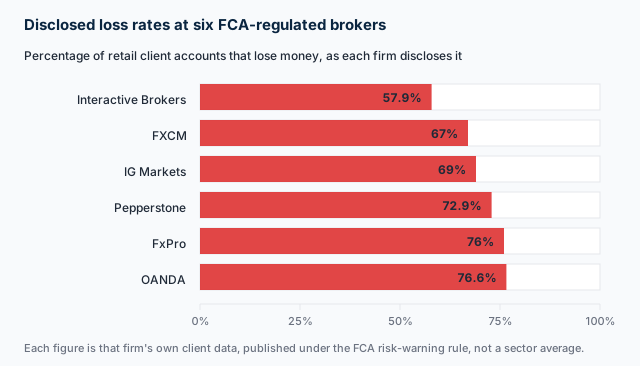
The chart shows the spread between the six disclosed figures, from 57.9% at Interactive Brokers to 76.6% at OANDA, a range of nearly twenty points across firms regulated under the same rules.
| Broker | Retail accounts losing money |
|---|---|
| Interactive Brokers | 57.9% |
| FXCM | 67% |
| IG Markets | 69% |
| Pepperstone | 72.9% |
| FxPro | 76% |
| OANDA | 76.6% |






As displayed in each firm’s UK risk warning, checked July 2026. Brokers update these figures quarterly; the set we track currently runs from 51% to 82% and moves over time. The spread between firms partly reflects client mix, not just execution quality, since a broker with more experienced, larger accounts tends to report a lower figure. A lower loss rate is context for a review, not a ranking signal on its own.
Why it matters for a UK trader
For you, these two numbers frame the opportunity honestly: deep, liquid markets sit inside UK hours, but most retail traders still lose. In my view, that loss rate is the single most important number on a broker’s site. I suggest you read it before opening an account; it sets a realistic expectation. The structural advantages, liquidity and FCA protection help, but they do not change the base rate of retail losses. What a realistic income looks like against that loss rate is set out in forex trader salaries in the UK. Testing an approach on a demo account before risking capital is one direct way to engage with the loss-rate figures above rather than just reading them.
Key considerations
I recommend you treat the loss-rate disclosure as the most important figure on a broker’s page, not the marketing above it. Use the liquidity advantage by trading the London and overlap hours, covered in the trading hours guide. Verify any statistic against its primary source, since figures shift between BIS surveys and FCA updates, and the wider forex education hub sets these numbers in context. Trading costs compound against the loss rate; see the lowest spread brokers guide for providers that reduce that drag. For you, every cost reduction matters.
Costs are the one line in this data a trader controls directly. Our broker cost calculator totals spread and commission across the brokers we track, and drawdown in forex trading UK covers the mechanic behind most of the loss-rate figures above.
Our reviews are reader-supported. We may receive payment when you click a link to a partner site. Learn how we make money.
FAQs
Is the UK the biggest forex market?
What percentage of forex traders lose money?
Why do most retail forex traders lose money?
How big is the global forex market?
Why do brokers report different loss rates?
Related pages
About the author

Justin Grossbard is the co-founder and CEO at CompareForexBrokers. He has traded forex since 1998, leads UK broker research and has personally reviewed every FCA-regulated broker on this site. His work has appeared in Forbes, Kiplinger and Finance Magnates, and he holds a Bachelor of Commerce (Honours) and a Master of Marketing.