
Risk warning: CFDs are complex instruments and come with a high risk of losing money rapidly due to leverage. The majority of retail investor accounts lose money when trading CFDs. You should consider whether you understand how CFDs work and whether you can afford to take the high risk of losing your money. This page is general information, not financial advice. Advertiser disclosure.
I always draw a hard line between an employed trading desk role and independent retail trading, because the income structure is completely different. A bank, fund or broker pays a wage plus bonus set by role, seniority and city, not by how your trades perform. Independent retail trading carries no wage: your income is whatever the account produces after costs, and most retail accounts lose money. That distinction matters before you treat trading as a career.
Employed trading roles and pay
| Role | Typical London base | Typical regional base | Bonus profile |
|---|---|---|---|
| Junior trader / trading analyst | £45,000 to £70,000 | £35,000 to £50,000 | 10% to 50% of base |
| Experienced desk trader | £90,000 to £150,000 | £65,000 to £100,000 | 50% to over 100% of base |
| FX portfolio manager (fund) | £120,000 to £200,000 | Rare outside London | Performance-linked, uncapped |
| Prop-firm trader | Draw £30,000 to £60,000 | Similar | Profit split replaces bonus |
| Broker account manager | £30,000 to £50,000 | £25,000 to £40,000 | Commission-weighted |
| Trading operations / support | £35,000 to £55,000 | £28,000 to £45,000 | 5% to 15% of base |
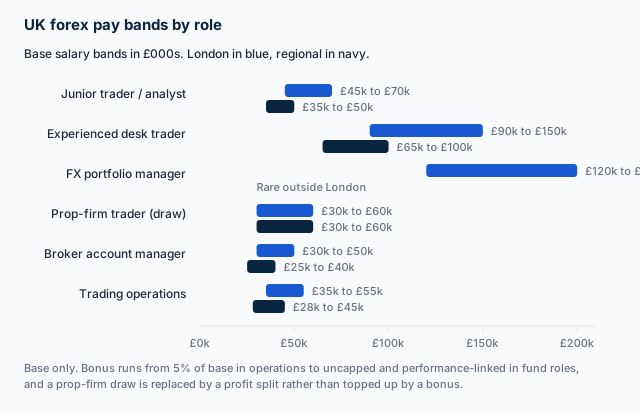
The chart lays out base bands by role, with London set against regional pay, from trading operations at the bottom to fund portfolio managers at the top. I find it helpful because it makes the London premium instantly visible as the gap between each pair of bars, so you can see where the real salary uplift sits.
Source: indicative ranges compiled from public UK salary aggregators (Glassdoor UK, Indeed UK and eFinancialCareers), checked July 2026. These are advertised and self-reported figures, not verified pay data, so I would confirm current figures directly, as individual offers vary widely by employer and desk.
Employed traders work at banks, hedge funds, proprietary firms and brokers, and their pay is set by role, seniority and employer, not by personal trading results. Aggregated UK listings put junior trading analysts at roughly £45,000 to £70,000 base in London, experienced desk traders at £90,000 to £150,000, and fund portfolio managers above that, with bonus often matching or exceeding base at senior levels. Support roles such as operations and account management sit on standard professional bands of roughly £30,000 to £55,000. These are advertised and self-reported aggregates, not guarantees, and the table above summarises the indicative bands for you.
Pay by UK location
London pays the highest base and by far the largest bonus pool, because banks and funds concentrate in the City and Canary Wharf. Aggregated listings for comparable roles in Edinburgh, Manchester and Leeds typically show base salaries around 15% to 30% below London, with a smaller or absent bonus component. Hybrid and remote arrangements at some proprietary firms have narrowed the base-pay gap, but bonus-weighted seats remain concentrated in London. I would weigh any London premium against living costs before treating it as a real difference for your take-home pay.
Independent trading is not a salary
An independent retail trader has no wage: income is whatever the account makes after costs, and it can be negative. Under the FCA’s product-intervention rules, brokers must publish the percentage of their retail accounts that lose money, and those disclosures run roughly 51% to 82% across the FCA-regulated firms we track (broker risk warnings, checked July 2026). The statistics guide sets out the full data. Treating retail trading as a reliable income ignores that base rate and the absence of any salary floor.
How employed and trading income are taxed in the UK
Employed trading income is taxed as normal UK employment income: Income Tax at 20% above the £12,570 Personal Allowance, 40% above £50,270 and 45% above £125,140, plus employee National Insurance at 8% up to £50,270 and 2% above, via PAYE. For you as an independent trader, CFD profits instead fall within Capital Gains Tax, with a £3,000 annual exempt amount for the 2026/27 tax year and 18% or 24% tax above it; spread-betting profits are not normally taxed and their losses attract no relief (HMRC rates, 2026/27 tax year, checked July 2026). See how CFDs are taxed.
Why it matters for a UK trader
The employed path is a salaried job with entry requirements: it runs through finance recruitment and qualifications, not through a retail trading account. I would not treat the independent path as a career unless you have a proven edge, because it has no wage, no floor, and a documented base rate of losing money. Judge it against the loss disclosures in the statistics guide, not against marketing. If you intend to trade anyway, test the strategy on a demo account first and see what it actually produces, then compare UK forex brokers on costs and execution, which our team covers, since running costs decide whether a live account is viable long term. Newer traders can start with the beginners guide.
Trading income and trading cost are different questions with the same answer at the end: what is left over. Our broker cost calculator prices the cost side across the FCA-regulated field, and UK forex trading statistics sets out how retail accounts actually fare. For the wider picture, start at our education hub.
Our reviews are reader-supported. We may receive payment when you click a link to a partner site. Learn how we make money.
FAQs
What is a forex trader's salary in the UK?
Can you make a living trading forex in the UK?
Do independent forex traders earn a salary?
How is forex trading income taxed in the UK?
Related pages
About the author

Justin Grossbard is the co-founder and CEO at CompareForexBrokers. He has traded forex since 1998, leads UK broker research and has personally reviewed every FCA-regulated broker on this site. His work has appeared in Forbes, Kiplinger and Finance Magnates, and he holds a Bachelor of Commerce (Honours) and a Master of Marketing.