
A CFD trading example is a worked calculation that shows, in my view, how a leveraged position gains or loses money against its margin once the spread or commission is counted. Two GBP examples below cover a forex buy and a share-CFD sell, each with a winning and a losing outcome.
Risk warning: CFDs are complex instruments and come with a high risk of losing money rapidly due to leverage. The majority of retail investor accounts lose money when trading CFDs. You should consider whether you understand how CFDs work and whether you can afford to take the high risk of losing your money. This page is general information, not financial advice. Advertiser disclosure.
| Position | Margin (FCA cap) | Move | Net result |
|---|---|---|---|
| GBP/USD long, 20,000 units (about £20,000) | £666.67 (30:1) | 150 pips either way | +£219.84 win, -£221.60 loss |
| UK share CFD short, £5,000 | £1,000 (5:1) | 4% either way | +£192 win, -£208 loss |
The GBP/USD row uses the exchange rate baked into this build, a GBP/USD rate of 1.3592 (28 August 2026), on a 0.6-pip spread. The share-CFD row assumes 0.08% commission at illustrative advertised rates. David Levy checked both rows in July 2026.
Buy example going long on GBP/USD
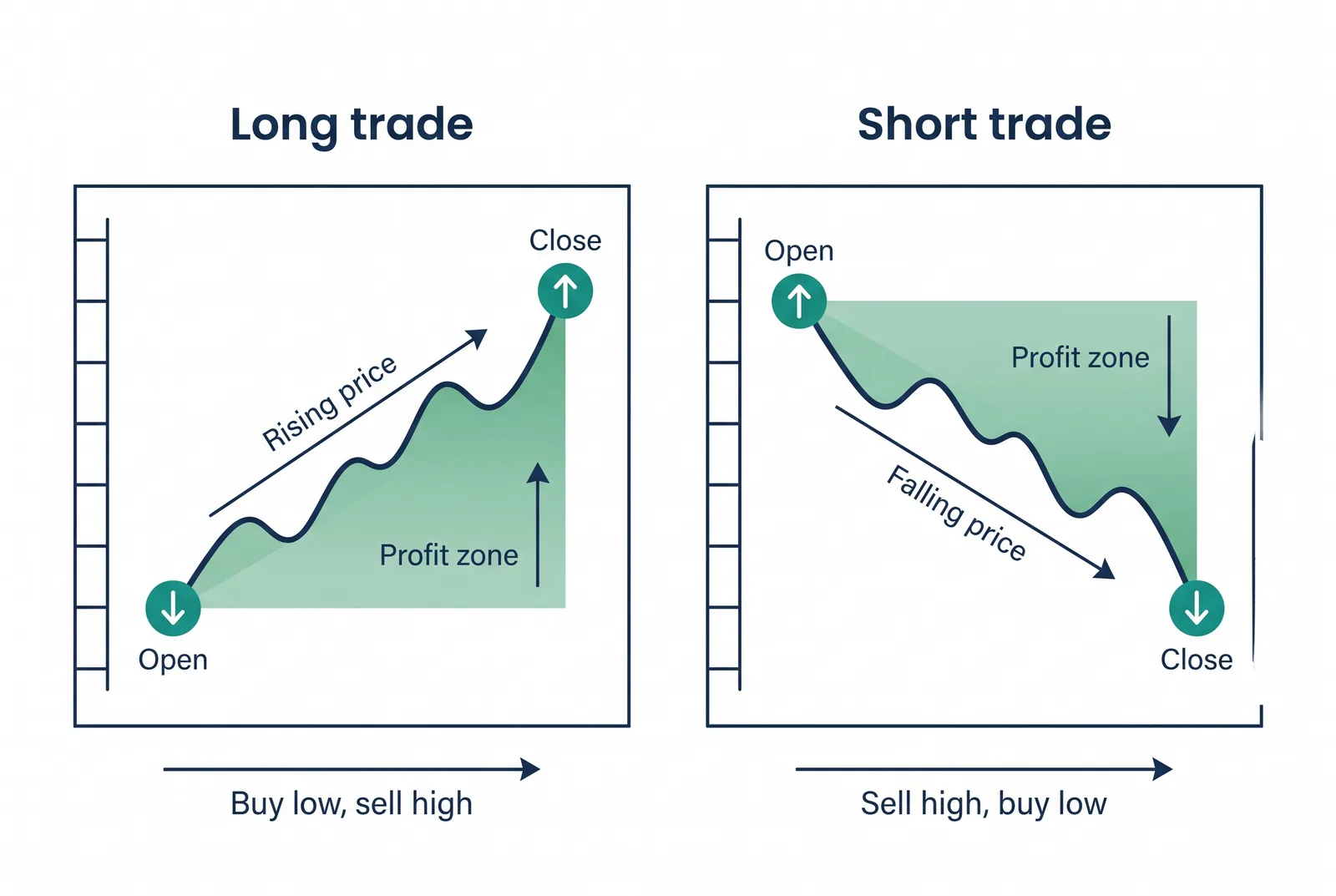
Suppose you buy 20,000 units of GBP/USD, about £20,000 of exposure, at the 30:1 major-pair cap, posting £666.67 in margin. Each pip is worth £1.47 at that size, at a GBP/USD rate of 1.3592 (28 August 2026). A 150-pip rise earns £220.72 before costs, and the 0.6-pip spread costs £0.88, so £219.84 net. The same 150-pip fall costs £220.72 plus the spread, £221.60, charged against your £666.67 margin, about 33% of it gone on one losing trade. In my view, that asymmetry between position size and margin is the whole point of a worked example. The deposit is small, the exposure is not. The 30:1 figure comes straight from the FCA’s PS19/18 leverage rules, and how margin close-out works sets the point at which a losing position is shut.
Profit / Loss Calculator
Rates as of Fri 28 Aug 2026, 5pm New York close
£220.72
- Price move150.0 pips
- Pip value at 0.20 lots£1.47
- DirectionBuy (long)
The calculator opens on exactly the trade above: 0.20 of a standard lot of GBP/USD bought at 1.3592 and closed at 1.3742, which is the 150-pip rise, returning £220.72 before the spread. I recommend running these numbers on your own entry and exit in the profit and loss calculator; it excludes overnight financing, which the costs section below covers.
Sell example shorting a UK share CFD
Share CFDs carry the 5:1 retail cap, so a £5,000 short position on a UK share needs about £1,000 in margin, with cost charged as a commission rather than a spread. Assume 0.08% per side, about £8 on the round turn. If the share falls 4%, the short gains about £200 before costs, roughly £192 net. A 4% rise instead loses about £200 plus commission, roughly £208 against your £1,000 margin. In my view, shorting a CFD is a straightforward way to profit from a falling price, something outright share buying cannot do.
What is the all-in cost of a CFD trade?
Every example has to include cost to be honest. For forex, the cost is the spread, and sometimes a commission on raw accounts. Share CFDs usually cost a commission plus overnight financing on positions held past the daily cut-off. A trade that looks profitable on price can be flat or negative once the all-in cost is counted. Because the spread is the main cost on the FX side, I suggest you compare lowest spread forex brokers before sizing a live position.
Held overnight, the same positions start paying financing. A long £5,000 share CFD charged at the Bank of England Bank Rate plus about 2.5%, an illustrative all-in rate near 6.5% on recent levels, costs roughly £0.90 per night, about £4.50 over a trading week, or more than half the round-turn commission. I find financing is the reason CFDs suit short holding periods; a multi-week view is usually cheaper in the underlying or an ETF.
The table below restates the two worked examples in structured form, each with its winning and losing outcome.
| # | Position | Margin | Outcome | Gross P&L | Costs | Net P&L |
|---|---|---|---|---|---|---|
| 1a | Long 20,000 GBP/USD | £666.67 | +150 pips | +£220.72 | £0.88 spread | +£219.84 |
| 1b | Long 20,000 GBP/USD | £666.67 | -150 pips | -£220.72 | £0.88 spread | -£221.60 |
| 2a | Short £5,000 UK share CFD | £1,000 | Share falls 4% | +£200 | about £8 commission | +£192 |
| 2b | Short £5,000 UK share CFD | £1,000 | Share rises 4% | -£200 | about £8 commission | -£208 |
Commission assumes 0.08% per side with a minimum charge. Both trades are closed the same day, so no overnight financing applies. David Levy confirmed the commission assumption during his check.
Common mistakes
- Reading only the price move and ignoring the spread or commission flatters every example.
- Forgetting overnight financing on multi-day positions understates the real cost.
- Sizing from the margin rather than the position leads to risk far above the intended pound amount.
You can avoid this mistake entirely by comparing costs across FCA-regulated broker reviews before opening an account.
Worked examples are the cheapest way to see a cost structure before you pay it. The same maths across the FCA-regulated field sits on our best CFD brokers UK hub, the contract itself is explained on what is CFD trading?, and the case against is set out on pros and cons of CFD trading for UK traders. For the wider picture, start at our education hub.
Our reviews are reader-supported. We may receive payment when you click a link to a partner site. Learn how we make money.
FAQs
How does a CFD trade make money?
What is the cost of a CFD trade?
Can you lose money on a CFD even if the price moves your way?
How much money do I need to trade these examples?
What happens if a losing CFD keeps falling?
Related pages
About the author

Justin Grossbard is the co-founder and CEO at CompareForexBrokers. He has traded forex since 1998, leads UK broker research and has personally reviewed every FCA-regulated broker on this site. His work has appeared in Forbes, Kiplinger and Finance Magnates, and he holds a Bachelor of Commerce (Honours) and a Master of Marketing.