
Risk warning: CFDs are complex instruments and come with a high risk of losing money rapidly due to leverage. The majority of retail investor accounts lose money when trading CFDs. You should consider whether you understand how CFDs work and whether you can afford to take the high risk of losing your money. This page is general information, not financial advice. Advertiser disclosure.
CFD trading gives you a leveraged way to speculate on price movements across forex, indices, shares and commodities from one FCA-regulated account. It suits you if you want short selling and broad market access, and it carries a high published retail loss rate any balanced view has to weigh.
What are the advantages of CFD trading?
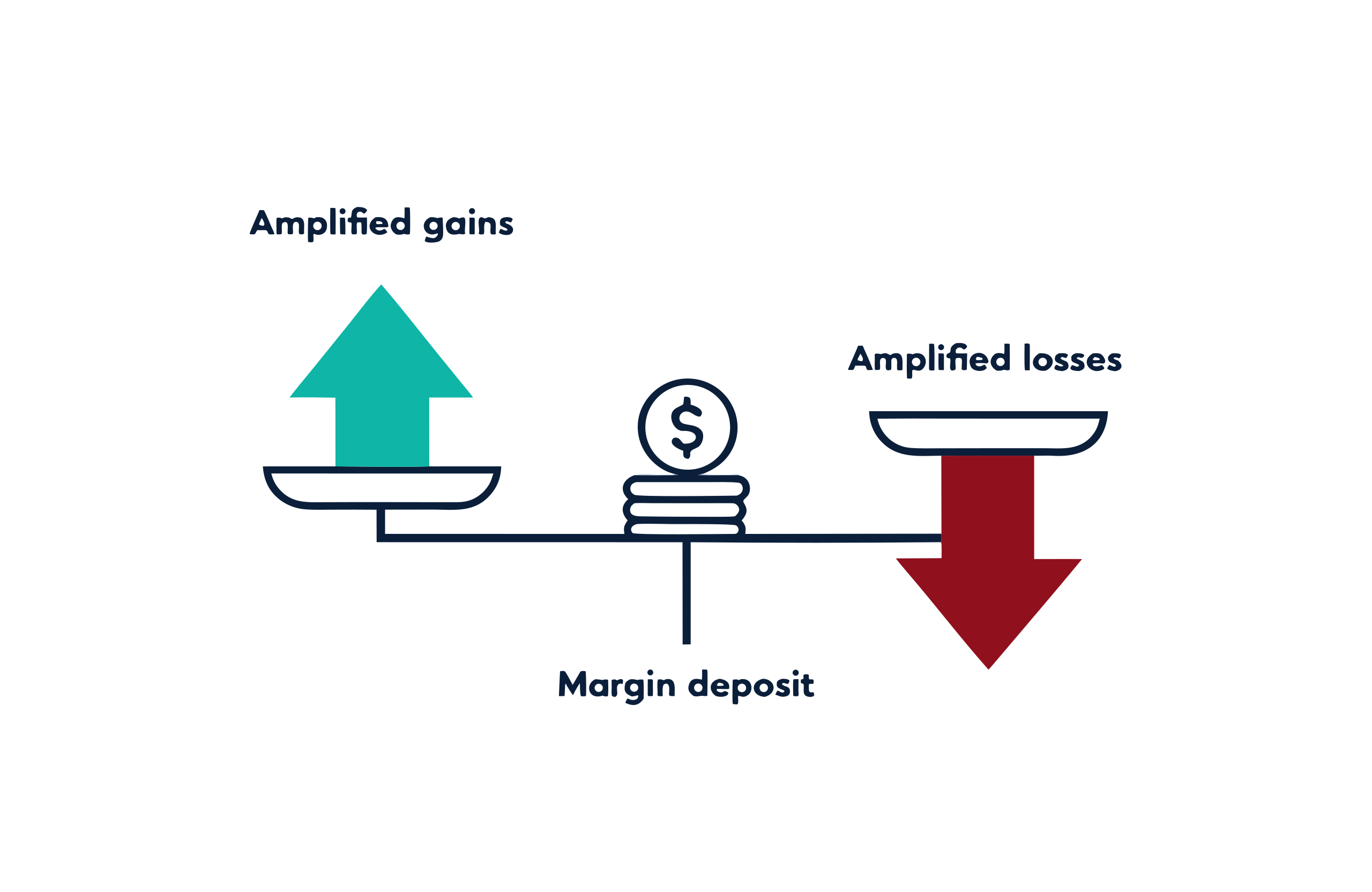
- Leverage lets a trader take a larger position than the cash deposited, within FCA caps.
- Short selling is straightforward, so a CFD can profit from a falling market.
- Market range is broad, covering forex, indices, shares and commodities from one account.
- UK tax treatment helps, since CFDs carry no stamp duty, unlike a direct share purchase.
If the mechanics are new to you, start with what a CFD is and how one works.
What are the disadvantages of CFD trading?
- Risk leads the list: FCA rules require every UK CFD provider to publish its own retail loss rate, and the disclosed figures span roughly 51% to 82% of accounts (range across UK CFD brokers’ FCA-required risk warnings, checked July 2026).
- Leverage cuts both ways, magnifying losses against the margin.
- Costs accumulate through the spread, any commission and overnight financing on held positions.
- A CFD confers no ownership, so there are no voting rights and dividends arrive only as a cash adjustment.
Comparing lowest commission forex brokers before choosing an account limits how much this eats into your returns.
| Advantage | Disadvantage |
|---|---|
| Leverage within FCA caps | Leverage magnifies losses against the margin |
| Straightforward short selling | Costs accumulate through spread, commission and overnight financing |
| Broad market range from one account | No ownership, voting rights or direct dividends |
| No UK stamp duty | Roughly 51% to 82% of retail accounts lose money (FCA-required broker disclosures, checked July 2026) |
| CFD losses can offset capital gains for CGT | Gains taxable under Capital Gains Tax above the annual exempt amount |
| Trade from a standard account, no wrapper needed | Not eligible for an ISA or SIPP, unlike shares and ETFs |
Published figures sit within that band rather than at a single point. Pepperstone, for example, discloses that 72.9% of its retail CFD accounts lose money (Pepperstone review, broker risk warning checked July 2026).
Why it matters for a UK trader
I view the FCA caps and retail protections as risk reducers, not odds changers; that is why the loss-rate disclosure exists. Weighing the leverage advantage against that loss statistic gives you a realistic view before opening an account. For a side-by-side look at CFDs versus owning the share, I recommend CFDs vs stocks.
Tax cuts both ways. A CFD escapes the 0.5% Stamp Duty Reserve Tax a UK share purchase carries, but gains fall within Capital Gains Tax and a CFD can never sit inside an ISA or SIPP, so the shelter long-term investors rely on is unavailable (see HMRC guidance; tax depends on individual circumstances and can change). Spread bets are taxed differently, a factual distinction covered elsewhere.
Key considerations
I recommend matching the product to your horizon: CFDs suit short-term, leveraged or hedging positions, not long-term buy-and-hold. Size positions to a fixed pound risk and use stops, because the FCA backstops are not substitutes. Practising position sizing on a demo account before trading live is the cheapest way to test the stops discussed above. Count the all-in cost on every trade, because frequent trading multiplies the spread. Reading FCA-regulated broker reviews before committing capital is the fastest way to check a broker’s cost and protection record, and our team tests broker platforms and accounts.
Weighing the product is a different job from weighing a provider. Our best CFD brokers UK hub ranks the FCA-regulated field, our margin calculator shows what a position actually ties up before you commit to one, and CFD trading examples UK works the costs through in GBP. For the wider picture, start at our education hub.
Our reviews are reader-supported. We may receive payment when you click a link to a partner site. Learn how we make money.
FAQs
What are the main advantages of CFD trading?
What are the risks of CFD trading?
Is CFD trading worth it in the UK?
Can I lose more than my deposit trading CFDs?
Do you pay tax on CFD profits in the UK?
Are CFDs banned in the UK?
Related pages
About the author

Justin Grossbard is the co-founder and CEO at CompareForexBrokers. He has traded forex since 1998, leads UK broker research and has personally reviewed every FCA-regulated broker on this site. His work has appeared in Forbes, Kiplinger and Finance Magnates, and he holds a Bachelor of Commerce (Honours) and a Master of Marketing.