
Verdict: trade short-term, leveraged or short positions with a CFD; build long-term wealth with an ETF inside an ISA or SIPP.
Risk warning: CFDs are complex instruments and come with a high risk of losing money rapidly due to leverage. The majority of retail investor accounts lose money when trading CFDs. You should consider whether you understand how CFDs work and whether you can afford to take the high risk of losing your money. This page is general information, not financial advice. Advertiser disclosure.
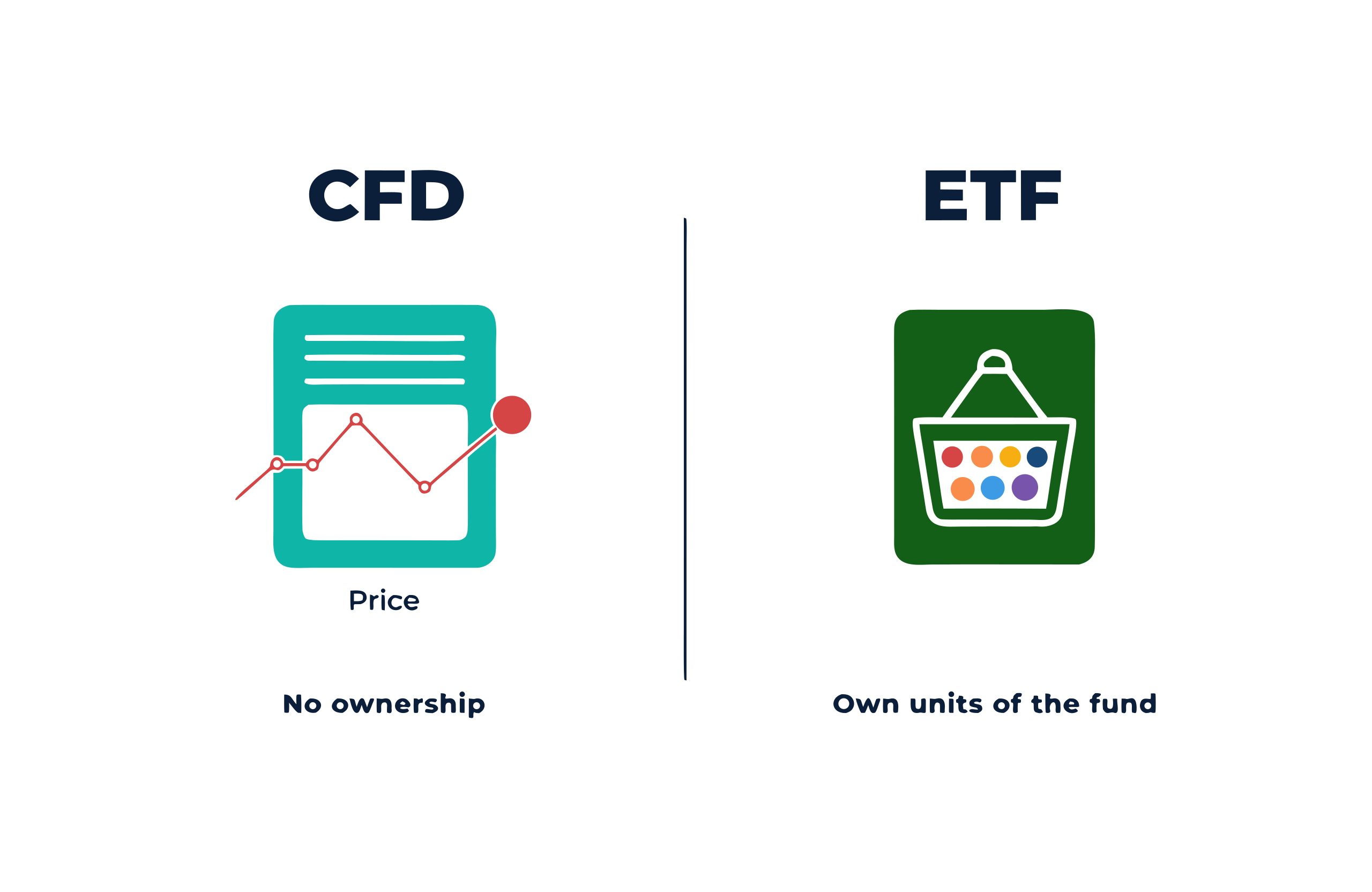
A CFD is a leveraged contract that tracks a market’s price without giving ownership; an ETF is a fund you own that tracks an index or sector. For UK traders, CFDs offer leverage and short selling within FCA caps, while ETFs can sit in an ISA or SIPP for tax-sheltered investing.
How each works
An exchange-traded fund holds a basket of assets and trades on an exchange like the LSE, so buying one makes you a part-owner of the fund. I would never use a CFD for long-term holding; I would only use them for short-term trades. A CFD tracks a price without ownership and uses leverage, capped at 20:1 on major indices and 5:1 on individual shares for retail clients under the FCA’s PS19/18 rules. For the CFD side of this comparison, share CFD brokers UK lists providers by leverage and cost. ETFs are bought outright and held; CFDs are opened with margin and usually closed within days or weeks.
| Feature | CFD | ETF |
|---|---|---|
| Ownership | None; the contract tracks the price | You own a share of the fund |
| Leverage | Up to 20:1 on major indices, 5:1 on shares for retail clients | None; bought outright |
| ISA/SIPP eligibility | Not eligible | Eligible for both |
| Stamp duty | None | 0.5% Stamp Duty Reserve Tax on some UK share ETFs; many index ETFs avoid it |
| Capital Gains Tax | Gains taxable above the annual exempt amount; losses can offset gains | Sheltered inside an ISA or SIPP; taxable in a general account |
| Income | No real distributions; dividend cash adjustments only | Real distributions, taxable outside a wrapper |
Tax treatment depends on individual circumstances and may change. Stamp Duty Reserve Tax, Capital Gains Tax and ISA/SIPP treatment follow HMRC and gov.uk guidance, checked July 2026.
UK tax and the ISA wrapper
ETFs on UK shares can incur 0.5% Stamp Duty Reserve Tax on purchase, though many index ETFs are structured to avoid it, while CFDs carry no stamp duty. The decisive UK difference is the wrapper: ETFs can be held in an ISA or SIPP, sheltering gains and income from tax, which CFDs cannot. CFD gains fall within Capital Gains Tax, with losses able to offset gains. A £10,000 gain on an ETF held in a Stocks and Shares ISA is tax-free; the same £10,000 gain on a CFD outside a wrapper falls within Capital Gains Tax above the current annual exempt amount. Tax treatment depends on individual circumstances and may change, and our team tests broker platforms and accounts. (SDRT, CGT and ISA rules per HMRC and gov.uk guidance, checked July 2026.)
Why it matters for a UK trader
I start with the goal. A trader wanting leveraged, short-term exposure, including the ability to short, uses a CFD. An investor wanting low-cost, long-term, diversified exposure uses an ETF and shelters it in an ISA or SIPP. That ISA shelter is why many UK long-term investors avoid leveraged CFD exposure. Once you have decided a CFD suits your trade, I suggest comparing best FCA-regulated forex brokers before opening an account.
Common mistakes
I see traders make this mistake: using a leveraged CFD to mimic a long-term index hold racks up financing and ignores the ISA shelter. That is why comparing lowest spread forex brokers matters before you open a leveraged position. Expecting an ETF to short or provide leverage misreads what a fund does. Overlooking that ETFs pay real distributions, while CFDs only adjust for them, distorts the income comparison. For the full picture, our CFD pros and cons guide weighs the wider trade-offs. More instrument comparisons are in the education hub.
Cost and tax decide most of this comparison, and both are easier to judge with a number in front of you. Our margin calculator shows what the CFD side ties up, and the share-versus-derivative version of the same question is on CFDs vs stocks for UK traders.
Our reviews are reader-supported. We may receive payment when you click a link to a partner site. Learn how we make money.
FAQs
What is the difference between a CFD and an ETF?
Can ETFs go in an ISA in the UK?
Which is better, a CFD or an ETF?
Do you pay Capital Gains Tax on ETFs?
Can you short an ETF?
Related pages
About the author

Justin Grossbard is the co-founder and CEO at CompareForexBrokers. He has traded forex since 1998, leads UK broker research and has personally reviewed every FCA-regulated broker on this site. His work has appeared in Forbes, Kiplinger and Finance Magnates, and he holds a Bachelor of Commerce (Honours) and a Master of Marketing.